
Hydration for Endurance Athletes: The Hidden Physiology Behind Fatigue, Performance, and Recovery
- May 26
- 9 min read

There is a moment almost every endurance athlete experiences at some point.
The pace has not changed.
The terrain has not changed.
The workout itself should still feel manageable.
But suddenly everything feels harder.
Your heart rate climbs for no obvious reason. Your legs begin feeling strangely heavy. Your thoughts become less sharp. Motivation fades. The effort starts feeling exponentially greater even though the output itself may not have changed very much.
Most athletes immediately assume “I’m out of shape. ”Or:“ I need to train harder.” But often, what they are actually experiencing is hydration physiology beginning to break down under prolonged stress. And that distinction matters enormously. Because endurance sports are not simply about muscles. They are about the body’s ability to maintain stability while under continuous physiological strain.
That changes how hydration works entirely.
Pre-work out hydration, during, or post-workout strategies.
In traditional gym workouts, dehydration may cause discomfort.
In endurance sports, dehydration changes performance physiology itself.
It alters:
cardiovascular efficiency,
thermoregulation,
cognitive function,
pacing strategy,
blood volume,
muscular endurance,
and nervous system regulation.
This is one reason elite endurance athletes obsess over hydration strategy long before race day ever arrives. Not because hydration is trendy. Because physiology always wins eventually. And the longer the event becomes, the more hydration begins determining whether the body can continue functioning efficiently under fatigue.
This is especially relevant now as endurance sports continue exploding in popularity.
Marathon running, HYROX, ultra-distance racing, Ironman competitions, trail running, long-distance cycling, run clubs, tactical fitness events, gravel racing, open-water swimming, and hybrid endurance competitions are growing rapidly across the world.
But many newer athletes entering these spaces still approach hydration with outdated thinking. Feel free to checkout our Complete Hydration Guide.
Most still view hydration as “drink water when thirsty.”
Modern endurance physiology tells a very different story.
Why Endurance Hydration Is Completely Different Than Regular Fitness Hydration

One of the biggest mistakes recreational athletes make is assuming hydration needs for a 45-minute gym workout are similar to those of endurance training.
They are not even close.
Endurance exercise places the body under prolonged physiological demand that compounds continuously over time.
The longer the effort lasts, the more difficult maintaining internal balance becomes.
Your body is constantly trying to regulate core temperature, plasma volume, blood pressure, oxygen delivery, muscular contraction, electrolyte balance, and nervous system stability all at once.
That balancing act becomes increasingly difficult as fluids and electrolytes continue disappearing through sweat and respiration.
This is why endurance fatigue often feels different than traditional muscular fatigue.
It is systemic.
A marathon runner late into a race is not simply experiencing tired legs. A cyclist several hours into a ride under humid conditions is not just low on energy. A HYROX athlete deep into a competition is not only battling muscular soreness.
The entire body is attempting to preserve homeostasis while under escalating physiological stress.
Research from Cheuvront and Kenefick published in Comprehensive Physiology demonstrated that dehydration progressively increases cardiovascular strain, thermoregulatory burden, and perceived exertion during prolonged exercise. Comprehensive Physiology – Dehydration & Performance
That last part matters enormously.
Perceived exertion.
Because endurance performance is heavily influenced not only by what the body can physically do, but by what the brain perceives the body can continue tolerating.
Hydration affects both.
The Cardiovascular Drift Most Endurance Athletes Feel But Don’t Understand
One of the most fascinating physiological phenomena in endurance sports is cardiovascular drift.
Most endurance athletes have experienced it even if they do not know the term.
You start a run feeling smooth and controlled. Your heart rate is stable. Breathing feels efficient.
Then gradually, despite maintaining the same pace, heart rate begins climbing anyway.
The effort suddenly feels disproportionately harder.
This happens because dehydration progressively reduces plasma volume.
As blood volume decreases, the heart must work harder to maintain cardiac output and oxygen delivery.
Essentially the cardiovascular system becomes less efficient as fluid losses accumulate.
Research from the American College of Sports Medicine consistently demonstrates that dehydration elevates heart rate and cardiovascular strain during endurance exercise.
This becomes particularly noticeable in:
long-distance running,
triathlon racing,
rucking,
ultra-endurance events,
and prolonged cycling sessions.
Athletes often interpret this as “my conditioning isn’t good enough.” But many times, hydration physiology is contributing heavily to the breakdown. This is one reason experienced endurance athletes often become highly strategic about hydration timing instead of waiting until they feel severe thirst.
By the time thirst becomes intense, cardiovascular efficiency has often already declined. So make sure you understand the signs of dehydration.
Why Heat Changes Everything
Heat completely changes endurance physiology.
I have seen too many people underestimate exercising in the heat without being properly hydrated and not monitoring their fluid intake throughout their exercise session. This has led to heat related injuries.
This is one reason athletes relocating from cooler climates to places like Miami or Tampa are often shocked by how much harder training suddenly feels.
Humidity and heat dramatically increase thermoregulatory demand.
The body must redirect increasing blood flow toward the skin to support cooling through sweat evaporation.
But this creates competition.
Blood flow now has competing responsibilities:cool the body while simultaneously supporting muscular performance.
As core temperature rises:
sweat losses accelerate,
plasma volume decreases,
cardiovascular strain rises,
and perceived exertion increases.
Research from Human Performance Resources by CHAMP (HPRC) consistently highlights how heat stress significantly impairs endurance performance and increases dehydration risk in both athletic and tactical populations.
This is why many athletes notice their pace slows, their recovery worsens, their heart rate climbs faster, and fatigue arrives earlier in hot conditions.
It is not weakness.
It is physiology.
Heat fundamentally changes the cost of maintaining performance.
Why Sodium Is More Important Than Most Athletes Think
Many endurance athletes understand they lose water through sweat.
Far fewer understand how important sodium becomes during prolonged exercise.
Sodium is not simply an electrolyte added to sports drinks for marketing.
It plays a major role in maintaining fluid balance, plasma volume, nerve signaling, muscular contraction, and blood pressure regulation.
As sweat losses accumulate during long training sessions or races, sodium losses accumulate too.
This is one reason some endurance athletes suddenly experience:
cramping,
dizziness,
headaches,
nausea,
mental fog,
or abrupt performance collapse late into events.
The issue is often not simply water loss.
It is fluid regulation beginning to destabilize.
Research published in the Journal of Athletic Training emphasized the importance of sodium replacement during prolonged exercise, especially under heat stress conditions. Journal of Athletic Training – Fluid Replacement Position Statement
This becomes especially important because sweat sodium concentrations vary dramatically between individuals.
Some athletes lose relatively small amounts.
Others lose enormous amounts of sodium during long endurance sessions.
This is one reason elite endurance hydration strategies are becoming increasingly individualized rather than relying on generic recommendations.
Why Endurance Fatigue Is Also Neurological
One of the most misunderstood aspects of endurance sports is that fatigue is not purely muscular.
The nervous system and brain play enormous roles in endurance performance regulation.
As physiological strain increases, the brain continuously evaluates:
hydration status,
thermal strain,
metabolic stress,
cardiovascular load,
and survival risk.
This influences pacing, motivation, perceived effort, and fatigue signaling.
Research from Ganio et al. demonstrated dehydration negatively affects:mood, focus, working memory, reaction time, and cognitive function. The Journal of Nutrition – Dehydration & Cognitive Performance
This becomes extremely relevant in endurance sports because endurance athletes make constant cognitive decisions during performance.
Should I increase pace?
Should I back off?
Can I sustain this effort?
Am I overheating?
Am I falling apart?
Late into endurance events, these decisions become harder because dehydration itself impairs cognitive performance.
This is one reason athletes often describe:mental collapse before physical collapse.
The brain begins reducing output before the body completely fails.
HYROX, Hybrid Fitness, and the New Era of Endurance Sports
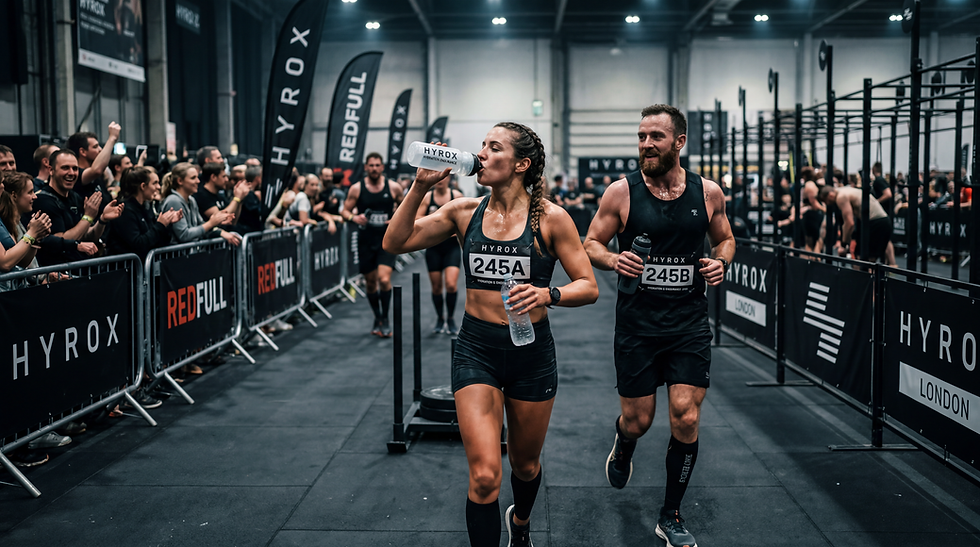
One of the most interesting shifts happening right now is the rise of hybrid endurance sports.
HYROX is a perfect example.
Unlike traditional endurance sports, HYROX combines:running, SkiErg intervals, sled pushes, rowing, lunges, wall balls, and repeated high-output stations under accumulating fatigue.
This creates a unique hydration challenge because athletes are simultaneously managing:
cardiovascular fatigue,
muscular fatigue,
heat production,
and nervous system stress.
Unlike marathon running where pace remains relatively steady, hybrid endurance sports involve repeated fluctuations in intensity.
This places enormous stress on the phosphagen system, glycolytic system, and aerobic system simultaneously.
Hydration becomes even more important because cardiovascular efficiency directly influences recovery between repeated high-output intervals.
This is one reason modern endurance hydration discussions increasingly include:creatine, sodium balance, intracellular hydration, and recovery physiology rather than only water intake.
Why Creatine Is Becoming More Relevant for Endurance Athletes
For years, many endurance athletes avoided creatine because they associated it exclusively with bodybuilding or unnecessary weight gain.
That perception is changing rapidly.
Modern research shows creatine supports ATP regeneration, intracellular hydration, repeated high-output efforts, recovery physiology, and even cognitive resilience.
This becomes particularly relevant in HYROX competitions, tactical fitness, cycling surges, hill climbs, sprint finishes, and hybrid endurance training.
Research published in the Journal of the International Society of Sports Nutrition continues supporting creatine’s role in exercise performance and recovery adaptation. JISSN – Creatine Position Stand
Creatine’s relationship with intracellular hydration is especially interesting for endurance athletes.
Hydration is not simply about how much water exists in the body.
It is also about where that water is distributed.
Proper cellular hydration supports energy production, muscular efficiency, and recovery capacity.
This is one reason the conversation around creatine has evolved far beyond aesthetics.
The Recovery Hydration Mistake Many Endurance Athletes Make
Many athletes focus heavily on hydration during training while completely neglecting recovery hydration afterward.
But recovery hydration may influence sleep quality, nervous system recovery, glycogen replenishment, soreness, mood, and next-day performance readiness.
The body does not stop losing fluids immediately after exercise ends.
Sweating often continues. Thermoregulation remains elevated. Heart rate recovery may take hours. The nervous system may remain highly stimulated.
Research from Armstrong et al. demonstrated mild dehydration negatively affects mood and fatigue perception after physiological stress. The Journal of Nutrition – Mild Dehydration & Mood
This is one reason endurance athletes sometimes feel:emotionally flat, mentally exhausted, or strangely depleted long after training finishes.
Recovery hydration is not simply replacing water.
It is restoring physiology.
Why the Best Endurance Athletes Manage Physiology Better
At the highest levels, endurance performance often becomes less about who can suffer the most and more about who can preserve efficiency the longest.
That includes:
hydration strategy,
sodium management,
thermoregulation,
fueling,
pacing,
and recovery.
The athletes who manage these variables effectively often appear calmer, smoother, and more controlled under stress.
Not because they are genetically superior.
Because physiology is being managed more intelligently.
This is where endurance sports are heading.
Not simply train harder. But, understand the body better.
Hydrate Smarter With HPSTIX
Endurance performance is not just about pushing harder.
It is about sustaining output while managing hydration, recovery, and physiological stress more effectively over time.
HPSTIX was designed to support hydration, cellular performance, and recovery with hydration-focused ingredients and creatine support built for real-world performance demands.
Whether you are training for a marathon, racing HYROX, cycling long distances, preparing for tactical fitness events, or simply trying to improve endurance and recovery quality, hydration matters.
Because the longer the effort becomes, the more physiology determines performance.
Explore more at HPSTIX
FAQs
Why is hydration so important for endurance athletes?
Hydration directly influences cardiovascular efficiency, thermoregulation, muscular endurance, cognitive performance, and recovery physiology. Even mild dehydration can significantly impair endurance performance and increase fatigue during prolonged exercise.
How does dehydration affect endurance performance?
As dehydration progresses, plasma volume decreases, heart rate rises, thermoregulation becomes less efficient, and perceived exertion increases. This often causes athletes to feel like workouts suddenly become much harder despite maintaining the same pace.
Why are electrolytes important during endurance exercise?
Electrolytes, especially sodium, help regulate fluid balance, nerve signaling, muscular contraction, and blood volume stability. During prolonged endurance exercise, electrolyte losses can significantly impair performance if not replaced appropriately.
Can dehydration affect cognitive performance during races?
Yes. Research consistently shows dehydration negatively affects mood, reaction time, focus, and mental clarity. Because endurance sports require pacing and decision-making, cognitive fatigue can significantly influence race performance.
Is creatine beneficial for endurance athletes?
Emerging evidence suggests creatine may support repeated high-output efforts, intracellular hydration, recovery physiology, and cognitive resilience in endurance and hybrid fitness athletes.
Why does heat make endurance workouts feel so much harder?
Heat increases thermoregulatory demand, cardiovascular strain, sweat loss, and nervous system stress. The body must work significantly harder to maintain performance while simultaneously trying to regulate internal temperature.
What is the best hydration strategy for endurance athletes?
The best strategy is individualized and depends on sweat rate, sodium losses, environment, exercise duration, and training intensity. Most endurance athletes benefit from combining fluids, electrolytes, carbohydrates, and consistent recovery hydration practices.
RESEARCH BACKED CITATIONS
Cheuvront, S. N., & Kenefick, R. W. (2014). Dehydration: Physiology, assessment, and performance effects. Comprehensive Physiology, 4(1), 257–285. https://doi.org/10.1002/cphy.c130017
Sawka, M. N., Cheuvront, S. N., & Carter, R. (2005). Human water needs. Nutrition Reviews, 63(6 Pt 2), S30–S39. https://doi.org/10.1111/j.1753-4887.2005.tb00152.x
Ganio, M. S., Armstrong, L. E., Casa, D. J., et al. (2011). Mild dehydration impairs cognitive performance and mood of men. The Journal of Nutrition, 141(8), 1535–1542. https://doi.org/10.3945/jn.111.139931
Armstrong, L. E., Ganio, M. S., Casa, D. J., et al. (2012). Mild dehydration affects mood in healthy young women. The Journal of Nutrition, 142(2), 382–388. https://doi.org/10.3945/jn.111.142000
Casa, D. J., Armstrong, L. E., Hillman, S. K., et al. (2000). National Athletic Trainers’ Association position statement: Fluid replacement for athletes. Journal of Athletic Training, 35(2), 212–224.
Kreider, R. B., Kalman, D. S., Antonio, J., et al. (2017). International Society of Sports Nutrition position stand: Safety and efficacy of creatine supplementation in exercise, sport, and medicine. Journal of the International Society of Sports Nutrition, 14(18). https://doi.org/10.1186/s12970-017-0173-z
Avgerinos, K. I., Spyrou, N., Bougioukas, K. I., & Kapogiannis, D. (2018). Effects of creatine supplementation on cognitive function of healthy individuals. Experimental Gerontology, 108, 166–173. https://doi.org/10.1016/j.exger.2018.04.013


