
Why You Feel Weak During Workouts: The Hidden Role of Hydration, Creatine, and ATP Production
Updated: Oct 8
Almost everyone who trains consistently has experienced it.
You walk into the gym expecting a solid workout, but something feels off almost immediately.
The warm-up feels heavier than normal. Your muscles feel flat. Your heart rate climbs faster than expected. Your focus feels scattered. Weights that normally move smoothly suddenly feel strangely difficult.
Most people instantly assume they are tired, under-recovered, or mentally unmotivated.
Sometimes that is true.
But often, weakness during workouts is not simply psychological.
It is physiological.
More specifically, it is frequently connected to hydration status, electrolyte balance, ATP turnover, nervous system fatigue, and intracellular energy production.
Ariel Hernandez’s Perspective on Why You Feel Weak During Workouts
If you were to ask Ariel Hernandez, Human Performance expert and Exercise & Nutrition Science specialist, why so many people feel weak during workouts, he would tell you that most individuals are looking at the wrong problem entirely.
Most people think weakness is simply a motivation issue, a sleep issue, or a lack of discipline. But in reality, your body is constantly communicating with you through performance output. When your body feels heavy, flat, sluggish, or unable to generate force, that is often your physiology signaling that your hydration status, recovery systems, ATP turnover, or nervous system are no longer functioning efficiently.
One of the biggest misconceptions in fitness is assuming hydration only matters for endurance athletes or people training in extreme heat. In reality, hydration directly affects your ability to produce force, regulate body temperature, maintain cardiovascular efficiency, recover between sets, and even maintain mental sharpness during training.
He explains that one of the first things he notices in tactical athletes, military members, healthcare professionals, and even general gym populations is that many people walk into workouts already under-hydrated and under-recovered before the first rep even begins.
Then they rely heavily on stimulants or pre-workout supplements to artificially increase energy output while their underlying physiology is struggling to maintain balance.
From a cellular perspective, your body’s ability to create and recycle ATP determines how powerful and energetic you feel during exercise. That process is heavily influenced by intracellular hydration and phosphocreatine availability. This is one reason creatine and proper hydration work so well together physiologically. When the body is properly hydrated and capable of efficiently regenerating ATP, force production, endurance, recovery, and cognitive performance all tend to improve together.
He also emphasizes that weakness during workouts is highly context-dependent. A strength athlete may experience dehydration as reduced explosiveness and slower bar speed, while a runner may experience it as elevated heart rate and heavy legs. A HYROX athlete may feel mentally foggy and unable to recover between stations, while military personnel training in heat may notice reaction time slowing and decision-making becoming more difficult.
According to him, the more in tune you become with your body, the easier it becomes to recognize the subtle warning signs before performance fully declines. Human performance is not simply about pushing harder. It is about understanding what your physiology is trying to tell you before breakdown occurs.”
The Cellular Energy Problem Most People Never Think About
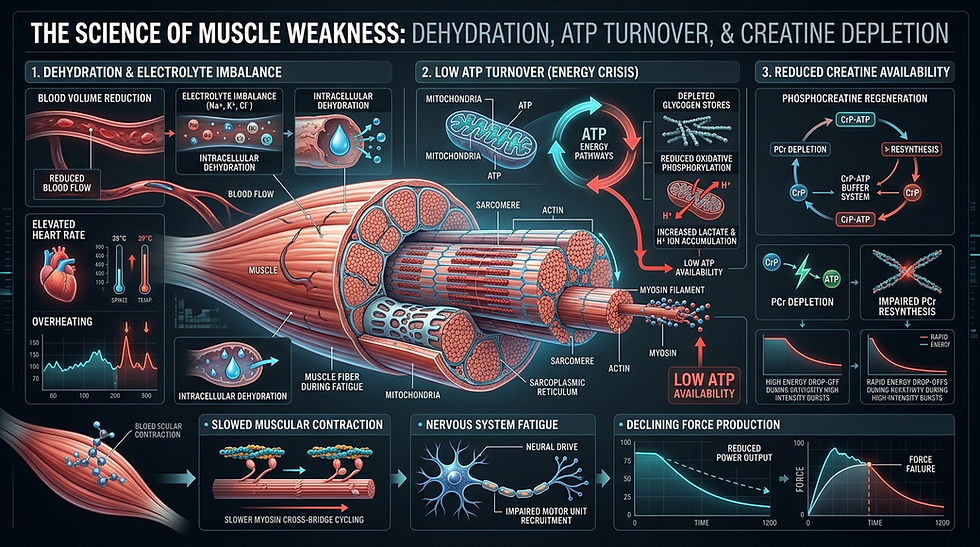
Most people think muscles fail because they “run out of strength.”
But physiologically, muscles fail because they begin struggling to sustain efficient energy production.
Everything in exercise physiology eventually comes back to ATP.
ATP, or adenosine triphosphate, is the body’s primary usable energy currency. Every muscular contraction, every explosive sprint, every heavy squat, and every rowing interval requires ATP.
The problem is that the body stores very little ATP at any given time.
Which means ATP must constantly be regenerated during exercise.
This is where hydration and creatine become deeply connected to performance.
When hydration status declines, blood volume decreases, thermoregulation becomes less efficient, nutrient delivery slows, and neural signaling becomes impaired. At the muscular level, ATP turnover becomes less efficient as physiological stress rises.
Eventually, workouts begin feeling heavy, flat, sluggish, or disproportionately difficult.
The body is still functioning.
It is simply functioning less efficiently.
Why Dehydration Makes Workouts Feel Harder So Quickly

One of the biggest misconceptions about dehydration is believing you must feel intensely thirsty before performance declines begin.
In reality, performance impairments often begin before people consciously recognize dehydration itself.
Research published in the European Journal of Applied Physiology demonstrated that even mild dehydration significantly reduces muscular endurance and increases perceived exertion during exercise.
This is one reason workouts suddenly feel harder than they should.
A strength athlete may notice slower bar speed and reduced explosiveness.
A runner may notice rising heart rate despite maintaining the same pace.
A HYROX athlete may feel unable to recover between stations.
A CrossFit athlete may suddenly feel dizzy or unable to sustain repeated output.
These are not always conditioning problems.
Often the body is struggling to maintain fluid balance and efficient ATP regeneration under stress.
Why Hydration Directly Influences Force Production
Most people associate hydration only with endurance. But hydration influences strength and power output too. Muscle tissue is heavily dependent on water for proper cellular function.
Hydration status affects electrolyte gradients, muscular contraction efficiency, nutrient delivery, and nervous system communication.
Research published in the Journal of Strength and Conditioning Research demonstrated dehydration significantly impairs muscular strength, power output, and repeated sprint performance.
This becomes especially noticeable during heavy lifting, sprint intervals, tactical fitness, Olympic lifting, combat sports, and repeated explosive training.
Explosive movement depends heavily on rapid ATP turnover and efficient nervous system signaling.
When hydration declines, both systems become less efficient simultaneously.
That inefficiency is often interpreted psychologically as “I just feel weak today.”
But weakness is often physiology before it becomes psychology.
Why Different Exercise Modalities Expose Weakness Differently
One of the reasons workout weakness feels confusing is because different forms of exercise expose dehydration differently.
Strength training exposes hydration problems differently than endurance training.
Endurance training exposes ATP limitations differently than repeated sprint intervals.
HYROX exposes weakness differently than bodybuilding. A maximal deadlift relies heavily on the phosphagen system and rapid ATP regeneration through phosphocreatine availability.
A long-distance run relies more heavily on aerobic metabolism, cardiovascular efficiency, and thermoregulation. Repeated sprint intervals require rapid ATP turnover while simultaneously managing metabolic accumulation and cardiovascular strain.
This is why dehydration can feel different depending on the workout itself.
During heavy strength work, dehydration often feels like reduced explosiveness or inability to generate tension.
During endurance exercise, dehydration may feel like elevated heart rate, heavy legs, overheating, and mental fatigue.
During high-intensity conditioning, dehydration often creates dizziness, nausea, tunnel vision, or inability to recover between efforts.
The body exposes stress through whichever physiological system is currently under the greatest demand.
Why ATP Turnover Determines How Powerful You Feel
One of the most overlooked concepts in exercise physiology is that “energy” is not simply a feeling.
It is biochemistry.
Your ability to rapidly regenerate ATP largely determines how explosive and powerful you feel during training.
This is where creatine becomes incredibly important.
The phosphocreatine system acts as a rapid ATP buffering system during high-output exercise. When ATP is broken down during muscular contraction, phosphocreatine helps rapidly regenerate ATP so muscular output can continue.
This system dominates during:sprinting, jumping, Olympic lifting, repeated explosive efforts, and high-intensity interval training.
Research published in the Journal of the International Society of Sports Nutrition consistently demonstrates creatine supplementation improves strength output, repeated sprint performance, muscular endurance, and recovery between repeated high-output efforts.
Without sufficient phosphocreatine availability, ATP regeneration slows.
When ATP regeneration slows, output declines.
That decline is often experienced subjectively as weakness.
The Nervous System Fatigue Most People Ignore

One of the biggest misconceptions in training is assuming muscular fatigue and nervous system fatigue are the same thing.
They are not.
The nervous system plays a massive role in force production.
Every movement requires communication between the brain, spinal cord, motor neurons, neuromuscular junctions, and muscle fibers.
Hydration status directly influences this communication.
Electrolytes such as sodium and potassium regulate nerve signaling, membrane potential stability, and muscular contraction.
When hydration and electrolyte balance begin declining, nervous system efficiency declines too.
Sometimes athletes describe this feeling as “I just couldn’t turn my brain on today.”
That sensation is often neurological fatigue layered on top of hydration stress.
Recover and Perform Smarter With HPSTIX
FAQs
Why do I suddenly feel weak during workouts?
Weakness during workouts is often connected to hydration status, ATP turnover, electrolyte balance, poor recovery, or nervous system fatigue. The body may struggle to maintain efficient energy production under stress even before obvious fatigue appears.
Can dehydration reduce strength performance?
Yes. Even mild dehydration can impair strength, power output, muscular endurance, cardiovascular efficiency, and recovery between sets. This often makes workouts feel significantly harder than normal.
How does creatine help improve workout performance?
Creatine helps regenerate ATP during high-output exercise. This supports explosiveness, repeated sprint performance, muscular endurance, recovery, and overall exercise capacity.
Why do workouts feel harder in hot weather?
Heat dramatically increases thermoregulatory demand, sweat loss, cardiovascular strain, and nervous system fatigue. The body must work harder to maintain performance while simultaneously cooling itself.
Can hydration affect mental focus during workouts?
Absolutely. Dehydration negatively affects focus, mood, reaction time, and cognitive performance, which can make workouts feel mentally exhausting in addition to physically difficult.
RESEARCH BACKED CITATIONS
Judelson, D. A., Maresh, C. M., Anderson, J. M., et al. (2007). Hydration and muscular performance. Journal of Strength and Conditioning Research, 21(4), 1162–1170.
Kreider, R. B., Kalman, D. S., Antonio, J., et al. (2017). International Society of Sports Nutrition position stand: Safety and efficacy of creatine supplementation in exercise, sport, and medicine.
Lieberman, H. R. (2007). Hydration and cognition: A critical review and recommendations for future research. Military Medicine, 172(11), 1170–1176.
Maughan, R. J., Shirreffs, S. M., & Watson, P. (2007). Exercise, heat, hydration and the brain. Journal of the American College of Nutrition, 26(5 Suppl), 604S–612S.


