
Does Creatine Make You More Thirsty? The Truth About Hydration, Water Retention, and Performance
Updated: Oct 8

If you've recently started taking creatine and suddenly find yourself reaching for your water bottle more often, you're not alone.
It's one of the most common questions people ask after beginning creatine supplementation "Does creatine make you more thirsty?"
Maybe you've noticed a dry mouth.
Maybe you're drinking more water throughout the day.
Or your workouts feel great, but you're wondering whether the increased thirst means you're becoming dehydrated.
For years, creatine has been surrounded by hydration myths. Some people still believe creatine causes dehydration. Others believe it causes cramping, and many think it forces your body to hold excessive amounts of water.
The truth is far more interesting, and much more relevant to human performance.
Current research suggests creatine does not cause dehydration in healthy individuals. In fact, many studies indicate the opposite may be true.
However, some people do report feeling thirstier after beginning creatine supplementation.
The question is why.
Understanding that answer requires understanding what creatine actually does inside the body, and more importantly, what it does not do.
We developed the DRINK Protocol to make this process simple for you!
If you've already read our articles on What If You Don't Drink Enough Water With Creatine?, Can You Mix Electrolytes With Creatine?, Should I Take Creatine If I Don't Workout?, or Does Creatine Make You Pee More?, you'll notice a common theme:
Many concerns surrounding creatine come from misunderstanding hydration physiology.
Once you understand how water moves through the body, the question of thirst becomes much easier to answer.
The Short Answer: Does Creatine Make You More Thirsty?
Creatine may make some people feel thirstier, but it does not appear to directly cause dehydration.
This distinction is critical.
Research consistently shows creatine supplementation is generally safe and does not increase dehydration risk in healthy individuals when used appropriately.
However, creatine influences cellular hydration.
Because of this, some individuals notice:
Increased thirst
Increased water intake
Greater awareness of hydration
Changes in fluid balance
In many cases, thirst is not a sign that something is wrong.
It may simply be feedback from the body's hydration regulation systems.
The body is communicating, and the goal is learning how to interpret that communication.
What Creatine Actually Does Inside the Body
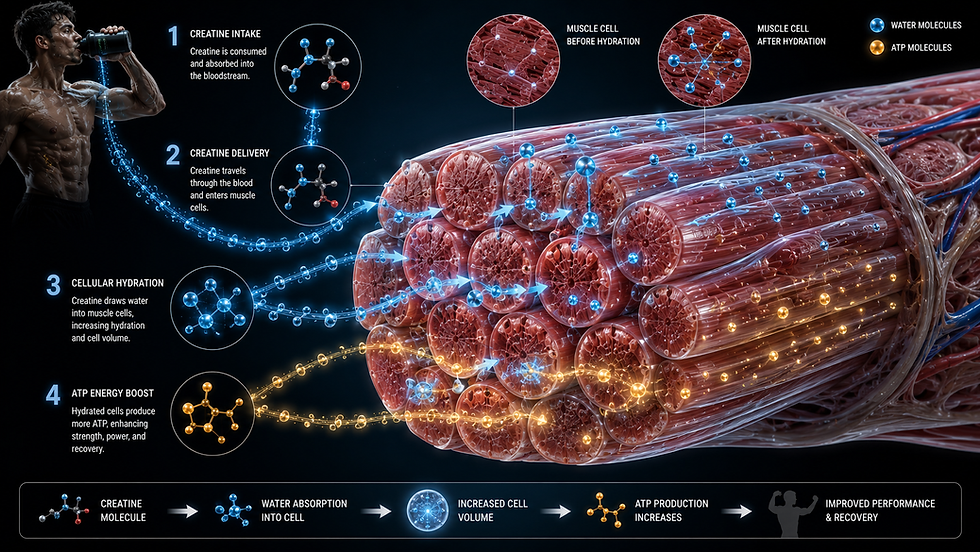
To understand thirst, we first need to understand creatine.
Most people know creatine as a muscle-building supplement.
That's technically true, but it's not the full story. Creatine's primary role involves energy production.
Inside muscle tissue, creatine helps support phosphocreatine stores. These stores assist in regenerating ATP. ATP is the body's primary energy currency.
Every sprint, jump, repetition, muscle contraction, and cellular process require ATP.
When ATP is depleted, performance declines.
Creatine helps support the rapid regeneration of ATP during high-intensity activity.
This is one reason creatine consistently improves:
Strength
Power
Training volume
Sprint performance
Lean mass development
But ATP isn't the only thing changing.
Water distribution changes too.
Creatine and Cellular Hydration

One of the most fascinating aspects of creatine is its influence on cellular hydration.
When creatine enters muscle tissue, it helps increase intracellular water content.
Let's simplify that.
Think of your body as having multiple water compartments.
Some water exists:
Inside cells
Outside cells
Within blood plasma
Within tissues
Creatine primarily influences water movement into muscle cells. This is often referred to as cell volumization.
The result? Muscle cells become better hydrated.
Many researchers believe this is one reason creatine supports:
Performance
Recovery
Training adaptations
Because well-hydrated cells tend to function more effectively than poorly hydrated cells.
This is not the same thing as bloating, nor is it the same thing as dehydration, it's a shift in water distribution.
Why Increased Cellular Hydration May Influence Thirst
Now we arrive at the question most people are actually asking.
If creatine pulls water into muscle cells, could that make you feel thirstier? Potentially.
The body's hydration system is incredibly sophisticated.
It continuously monitors:
Fluid balance
Electrolyte concentrations
Blood volume
Osmolality
When changes occur, thirst mechanisms may respond. This doesn't mean creatine is causing a problem. It simply means the body has detected a change in fluid distribution.
Some people notice this more than others. This is one reason two individuals taking identical doses of creatine may have completely different experiences.
Human physiology is highly individualized.
The Hidden Reason Many People Feel Thirstier
Here's something most fitness articles never discuss. Many people begin taking creatine while already mildly dehydrated.
Not severely dehydrated, not medically dehydrated, just under-hydrated enough that performance isn't optimal.
This is surprisingly common.
Especially among:
Office workers
Students
Busy parents
Travelers
Athletes who underestimate sweat losses
When creatine enters the picture, people often begin paying more attention to hydration.
They start:
Drinking more water
Monitoring urine color
Tracking supplement intake
Suddenly they notice thirst signals that were already present.
The assumption becomes "Creatine is making me thirsty."
In some cases, creatine may simply be exposing hydration habits that weren't ideal to begin with.
Does Thirst Mean Creatine Is Working?
This is another common question.
The answer is, Not necessarily.
Some individuals experience increased thirst during creatine supplementation, others experience none. Neither response determines whether creatine is effective.
Creatine works by increasing phosphocreatine availability and supporting ATP regeneration. Those processes occur regardless of whether thirst changes. Using thirst as a measure of effectiveness is unreliable.
Performance improvements are far more meaningful indicators.
Examples include:
Increased strength
Improved recovery
Better training capacity
Enhanced high-intensity performance
Those outcomes tell a more accurate story.
Creatine, Water Retention, and the Biggest Myth in Fitness
One reason thirst concerns persist is because people hear the phrase "Creatine causes water retention."
Then they assume:
Water retention equals dehydration, water retention equals bloating, or water retention equals unhealthy weight gain.
None of those assumptions are necessarily correct. As discussed in Do Electrolytes Make You Gain Weight?, fluid retention can be entirely normal.
The body is constantly regulating water, and healthy hydration requires fluid retention. Without retaining water, hydration would be impossible.
The real question is where the water is being retained, and creatine primarily increases intracellular water.
That means water stored inside muscle cells.
This is very different from the type of fluid retention people typically associate with bloating.
Understanding this distinction eliminates much of the fear surrounding creatine.
Summer Training, Sweat Loss, and Creatine
This is where context becomes critical.
A person sitting in an air-conditioned office has different hydration demands than:
A runner
A tactical athlete
A construction worker
A firefighter
A hot yoga practitioner
When environmental heat increases, fluid losses increase. Sweat losses increase, electrolyte losses increase.
In these situations, thirst may become more noticeable, not because creatine is causing dehydration, but because overall hydration demands have increased.
Creatine often gets blamed for problems that are actually being driven by:
Heat exposure
Increased training volume
Sweat losses
Poor hydration habits
This is particularly common during summer months.
Creatine and Electrolytes: An Important Relationship
One of the biggest hydration mistakes people make is focusing exclusively on water.
Hydration involves more than fluid, and it also involves electrolytes.
As discussed in Can You Mix Electrolytes With Creatine?, electrolytes help regulate:
Fluid balance
Nerve signaling
Muscle contractions
Hydration efficiency
When individuals dramatically increase water intake without considering electrolyte intake, hydration can become less efficient.
This is one reason many athletes pair creatine supplementation with a thoughtful hydration strategy.
Not because creatine requires massive amounts of water.
But because performance benefits from proper hydration.
Ariel Hernandez's Perspective: Creatine Doesn't Create the Problem, It Often Reveals It
One of the most interesting patterns Ariel Hernandez has observed while coaching military tactical athletes, and active adults is how often creatine gets blamed for hydration issues that were already present.
Someone begins taking creatine.
A week later they notice they're thirstier.
The immediate conclusion is "Creatine is dehydrating me."
But when Ariel starts asking questions, a different story often emerges.
How much water were you drinking before?
How much are you sweating now?
Has training volume increased?
Are you spending more time outdoors?
Have you started paying attention to hydration for the first time?
Suddenly the conversation changes, because what looked like a creatine problem is often a hydration awareness problem.
From Ariel's perspective, one of the most valuable things creatine does is force people to think about hydration.
Many active adults operate in a state of chronic underhydration for years without realizing it.
Then creatine enters the picture and hydration finally becomes part of the conversation.
As Ariel often explains, "Creatine doesn't usually create hydration problems. It tends to expose the hydration habits that were already there."
That's an important distinction.
Because when people stop blaming creatine and start understanding hydration, they usually become healthier, recover better, and perform better.
The DRINK Protocol: A Smarter Way to Stay Hydrated While Taking Creatine
One of the biggest mistakes people make after starting creatine is immediately searching for a hydration formula.
How much water should I drink?
Do I need electrolytes?
Am I drinking too much?
Am I drinking too little?
The reality is that hydration isn't a single number.
It's a dynamic process that changes based on:
Body size
Activity level
Sweat rate
Climate
Nutrition
Exercise demands
That's why Human Performance HQ developed the DRINK Protocol.
Not as a rigid hydration rule.
But as a practical framework for understanding how creatine and hydration work together.
D — Determine Baseline Hydration
Before asking whether creatine is making you thirsty, it's important to evaluate where your hydration status was before supplementation.
Many people begin creatine while:
Drinking too little water
Consuming excessive caffeine
Traveling frequently
Exercising in hot environments
If hydration wasn't optimal beforehand, thirst may become more noticeable once creatine enters the picture.
The supplement didn't necessarily create the issue.
It simply helped bring attention to it.
R — Recognize Water Shifts
One of creatine's most well-established effects involves cellular hydration.
Water shifts into muscle cells, this is normal, it's expected, And it's one reason many researchers view creatine as more than a performance supplement.
Well-hydrated cells tend to function better than poorly hydrated cells.
Recognizing that these fluid shifts are physiological, not pathological, and helps reduce unnecessary concern.
I — Increase Awareness
Hydration awareness is often more valuable than hydration perfection.
Pay attention to:
Thirst
Energy levels
Recovery
Urine color
Exercise performance
Your body provides feedback continuously.
Most people simply aren't listening.
N — Normalize Fluid Intake
Hydration should be consistent.
One of the biggest mistakes people make is drinking almost nothing throughout the day and then attempting to "catch up" at night.
The body generally responds better to steady fluid intake.
Think consistency rather than extremes.
K — Keep Electrolytes Balanced
Water matters, just don’t forget electrolytes matter too.
As discussed in Can You Mix Electrolytes With Creatine?, electrolytes help regulate:
Fluid distribution
Muscle contractions
Nerve function
Hydration efficiency
The goal isn't simply drinking more, it's supporting hydration intelligently.
This may be the most searched creatine question online, and unfortunately, there isn't a universal answer.
Hydration needs vary dramatically between individuals.
A 120-pound office worker in a cool environment has different requirements than:
A marathon runner
A tactical athlete
A firefighter
A laborer in Florida heat
Most research does not support the idea that creatine requires excessive water intake.
What matters most is maintaining normal hydration habits.
Practical signs of adequate hydration often include:
Light-colored urine
Stable energy levels
Normal recovery
Appropriate thirst response
Hydration should support performance.
Not become another source of stress.
Does Creatine Cause Dehydration?
This myth refuses to die. For years, people believed creatine increased dehydration risk, but modern research consistently challenges that assumption.
Multiple studies have found no evidence that creatine increases dehydration risk in healthy individuals.
In fact, some researchers have suggested creatine may help support thermoregulation and hydration during exercise.
This doesn't mean hydration becomes unimportant, it means creatine should not automatically be viewed as a dehydration risk.
The science simply doesn't support that narrative.
Athletes, Creatine, and Thirst
Athletes often experience hydration differently than the general population.
Why? Because athletes frequently operate under conditions that increase fluid losses.
Examples include:
Long runs
High-volume training
Heat exposure
Sweating
Competition
In these situations, thirst can increase regardless of creatine use.
This creates a common misunderstanding.
The athlete notices increased thirst.
Creatine gets blamed.
The actual cause may be:
Higher training volume
Environmental heat
Increased sweat losses
Hydration demands rise as performance demands rise, that's normal physiology.
Tactical Athletes and Summer Training

Few groups understand hydration challenges better than military personnel.
Tactical athletes often combine:
Load carriage
Running
Strength training
Heat exposure
Occupational stress
within the same training cycle.
This creates significant fluid requirements.
When creatine supplementation is added, thirst may become more noticeable simply because overall hydration demands are higher.
This is one reason military human performance programs increasingly emphasize hydration education.
The supplement isn't the issue, the environment and workload is.
The physiological demands are.
If you've read our article Electrolytes for Hot Yoga, you already know how dramatically sweat losses can increase during heated sessions.
Many practitioners lose substantial amounts of fluid. They also lose electrolytes.
When creatine is combined with hot yoga, hydration awareness becomes especially important.
Not because creatine creates dehydration, but because the environment creates additional fluid demands.
The hotter the environment, the more important hydration becomes. The body doesn't care whether you're running a marathon or holding Warrior II.
Sweat losses still matter.
Creatine, Electrolytes, and Performance
One of the most overlooked aspects of creatine supplementation is how closely hydration and performance are connected.
Hydration influences:
Strength
Power
Recovery
Endurance
Cognitive performance
Electrolytes help regulate many of these systems.
This is why high-performing athletes rarely think in terms of "Water versus electrolytes."
Instead, they think "How do I support performance?"
Creatine supports energy systems.
Electrolytes support fluid regulation.
Together they support human performance.
Common Hydration Mistakes People Make While Taking Creatine
Many hydration issues attributed to creatine are actually caused by poor habits.
Examples include Drinking Massive Amounts of Water
More isn't always better.
Excessive water intake can create problems of its own.
Ignoring Electrolytes
Hydration isn't only about water. Fluid regulation depends on electrolyte balance.
Waiting Until You're Extremely Thirsty
Thirst is useful feedback, but it shouldn't be the only hydration strategy.
Assuming Every Symptom Is Creatine
Fatigue, headaches, and poor recovery. These can result from numerous factors. Creatine often gets blamed for unrelated issues.
Forgetting Environmental Factors
Heat, humidity, travel, and exercise dramatically influence hydration requirements.
Context matters.
Ariel Hernandez's Perspective: Learn What Your Body Is Telling You
One of the biggest shifts Ariel Hernandez tries to create when working with active adults is helping them move away from fear-based hydration.
People want exact rules.
Exactly how much water should I drink?
Exactly how often should I be thirsty?
Exactly how often should I pee?
The body rarely operates with that level of precision.
What matters more is learning to interpret feedback.
Your body is remarkably intelligent.
It provides signals constantly:
Thirst
Urine color
Energy
Recovery
Exercise performance
These signals aren't inconveniences. They're information.
From Ariel's perspective, one of the most valuable outcomes of creatine supplementation is that it often encourages people to become more aware of hydration.
That awareness frequently improves habits that were already limiting performance.
As Ariel often explains, "The goal isn't to drink the perfect amount of water. The goal is to become aware enough that your body can guide you toward what it needs."
That's where hydration becomes human performance.
Not through rigid formulas.
Through understanding physiology.
Stay Connected With Human Performance HQ
Join the Human Performance HQ newsletter at the bottom of the page for science-backed education on:
Creatine
Hydration
Electrolytes
Recovery
Cognitive performance
Longevity
Human performance optimization
Get evidence-based strategies delivered directly to your inbox.
Perform. Evolve. Achieve.
FAQs
Does creatine make you thirsty?
Some people report increased thirst after starting creatine, but research does not suggest creatine directly causes dehydration. In many cases, thirst may reflect changes in hydration awareness, training demands, or fluid distribution within the body. The experience varies significantly between individuals.
Why am I thirstier after taking creatine?
Creatine influences cellular hydration and may alter how water is distributed throughout the body. Additionally, many individuals begin paying closer attention to hydration once they start supplementation. Increased thirst is often related to overall hydration status rather than creatine itself.
Does creatine cause dehydration?
Current research does not support the idea that creatine causes dehydration in healthy individuals. Several studies have found no increase in dehydration risk during exercise when creatine is used appropriately. Proper hydration habits remain important regardless of supplementation.
How much water should I drink with creatine?
There is no universal number because hydration needs vary based on body size, activity level, environment, and sweat losses. Most individuals simply need to maintain normal hydration habits while taking creatine. Consistency matters more than forcing excessive water intake.
Do I need electrolytes when taking creatine?
Not necessarily, but electrolytes can be beneficial for individuals who sweat heavily, train intensely, or exercise in hot environments. Electrolytes help regulate fluid balance and support hydration efficiency. They complement hydration strategies rather than replace water.
Is thirst a sign creatine is working?
No. Some people feel thirstier while taking creatine, while others do not. Creatine's effectiveness is better measured through improvements in strength, power, recovery, and training performance rather than thirst sensations.
Can creatine make you pee more?
It can in some situations, particularly if overall fluid intake increases. However, creatine itself is not a diuretic. As discussed in our article Does Creatine Make You Pee More?, changes in urination often reflect hydration status rather than a problem with the supplement.
RESEARCH BACKED CITATIONS
Kreider, R. B., Kalman, D. S., Antonio, J., Ziegenfuss, T. N., Wildman, R., Collins, R., Candow, D. G., Kleiner, S. M., Almada, A. L., & Lopez, H. L. (2017). International Society of Sports Nutrition position stand: Safety and efficacy of creatine supplementation in exercise, sport, and medicine. Journal of the International Society of Sports Nutrition, 14(18).https://jissn.biomedcentral.com/articles/10.1186/s12970-017-0173-z
Antonio, J., Candow, D. G., Forbes, S. C., Gualano, B., Jagim, A. R., Kreider, R. B., Rawson, E. S., Smith-Ryan, A. E., VanDusseldorp, T. A., Willoughby, D. S., & Ziegenfuss, T. N. (2021). Common questions and misconceptions about creatine supplementation: What does the scientific evidence really show? Journal of the International Society of Sports Nutrition, 18(13).https://jissn.biomedcentral.com/articles/10.1186/s12970-021-00412-w
Rawson, E. S., & Venezia, A. C. (2011). Use of creatine in exercise and health. Amino Acids, 40(5), 1363–1372.https://link.springer.com/article/10.1007/s00726-011-0855-3
Rosene, J., Matthews, T., Ryan, C., Belmore, K., Bergsten, A., Blaisdell, J., Greene, K., & Housh, T. J. (2009). Short and longer-term effects of creatine supplementation on hydration status. Journal of Athletic Training, 44(2), 215–219.https://www.ncbi.nlm.nih.gov/pmc/articles/PMC2663530/
Lopez, R. M., Casa, D. J., McDermott, B. P., Ganio, M. S., Armstrong, L. E., & Maresh, C. M. (2009). Does creatine supplementation hinder exercise heat tolerance or hydration status? A systematic review with meta-analyses. Journal of Athletic Training, 44(2), 215–223.https://www.ncbi.nlm.nih.gov/pmc/articles/PMC2663536/
Other Resources
International Society of Sports Nutrition Position Stand on Creatine https://jissn.biomedcentral.com/articles/10.1186/s12970-017-0173-z
Common Questions and Misconceptions About Creatine Supplementation https://jissn.biomedcentral.com/articles/10.1186/s12970-021-00412-w
Cleveland Clinic – Creatine: Benefits and Safety https://my.clevelandclinic.org/health/treatments/17674-creatine
Mayo Clinic – Creatine Supplement Overview https://www.mayoclinic.org/drugs-supplements-creatine/art-20347591
National Academy of Sports Medicine – Creatine Research Review https://blog.nasm.org/sports-performance/creatine-supplementation
Human Kinetics – Creatine and Athletic Performance https://us.humankinetics.com/blogs/excerpt/creatine-and-athletic-performance


