
Are Electrolytes Salty?
Updated: Oct 8
Understanding Sodium, Hydration, and Why Your Body Craves Salt

Take a sip of an electrolyte drink and one of two things usually happens.
You either think "This tastes amazing." or, "Why is this so salty?"
It's one of the most common questions people ask when they first start using hydration products.
Are electrolytes salty?
The short answer is yes, many electrolyte drinks have a salty taste because sodium is one of the most important electrolytes in the human body.
But that answer barely scratches the surface. Because the real question isn't whether electrolytes are salty.
The real question is:
Why does the body need sodium in the first place?
For decades, sodium has been portrayed as something people should avoid.
Yet athletes actively consume it.
Military personnel are encouraged to replace it.
Construction workers often need more of it.
Endurance athletes sometimes crave it.
And many people notice they feel dramatically better after replacing it.
How can all of those things be true simultaneously?
The answer lies in understanding the difference between sodium as a health risk and sodium as a performance tool.
Context matters.
And when it comes to hydration, sodium may be one of the most misunderstood nutrients in human performance.
This is why we created the SALT Protocol.
If you've already read our articles on Electrolyte Drinks for Labor, Hydration for
Endurance Athletes, Electrolytes for Hot Yoga, or How Hydration Affects Physical Performance, you've probably noticed a recurring theme:
Hydration is not simply about drinking water.
It's about fluid regulation and sodium plays a major role in that process.
So, Are Electrolytes Salty?
Technically, not all electrolytes are salty.
But the electrolyte most people notice is sodium.
Sodium is the primary electrolyte responsible for the salty taste found in many hydration products.
Electrolytes themselves are minerals that carry electrical charges when dissolved in fluids.
The major electrolytes include:
Sodium
Potassium
Magnesium
Calcium
Chloride
Each serves different physiological functions.
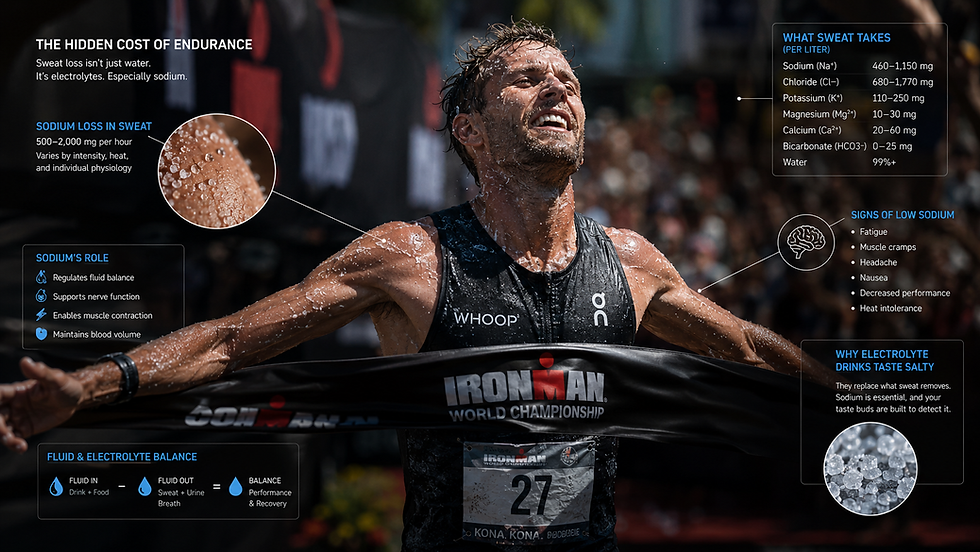
However, sodium is typically present in the largest amounts in many electrolyte beverages because sodium is also the primary electrolyte lost through sweat.
When you drink an electrolyte beverage and notice a salty flavor, you're often tasting the sodium that was intentionally included to support hydration.
The irony is that the ingredient many people complain about tasting is often the ingredient providing the greatest hydration benefit.
Why Sweat Tastes Salty
Have you ever finished a workout and noticed white residue on your clothing?
Or tasted sweat running down your face?
That salty flavor isn't your imagination.
Sweat contains sodium.
In fact, sodium is one of the primary electrolytes lost through sweating.
According to the American College of Sports Medicine Position Stand on Exercise and Fluid
Replacement, sodium losses during exercise can vary dramatically between individuals, with some people losing substantially more sodium than others.
This creates an interesting challenge.
Every time you sweat, you aren't simply losing water.
You're losing:
Water
Sodium
Chloride
Smaller amounts of potassium and other electrolytes
This is one reason hydration becomes more complicated than simply drinking water.
Because replacing water alone doesn't always replace what was lost.
Why the Body Wants Sodium
Many people have been taught that sodium is something to avoid.
The reality is more nuanced.
Sodium is essential for life.
Without sodium, the body cannot effectively regulate:
Fluid balance
Blood pressure
Nerve signaling
Muscle contractions
Cellular communication
From a human performance perspective, sodium is one of the most important electrolytes in the body.
It helps determine how fluids move throughout tissues.
It helps maintain plasma volume.
It helps support cardiovascular function.
This is why sodium replacement becomes increasingly important during:
Long workouts
Hot weather
Endurance sports
Outdoor labor
Military training
Hot yoga
The body loses sodium through sweat and in many situations, replacing that sodium becomes beneficial.
The Difference Between Table Salt and Electrolytes
One of the most common misconceptions is that electrolytes are simply fancy salt.
Not exactly.
Table salt primarily contains sodium chloride.
Electrolyte products often contain:
Sodium
Potassium
Magnesium
Calcium
Chloride
The objective isn't simply adding salt.
The objective is supporting the broader electrolyte system responsible for fluid regulation and performance.
Think of sodium as one player on a team, an important player. Perhaps the most visible player, but still part of a larger system.
This distinction becomes especially important when evaluating electrolyte products.
Not all hydration products are created equal, and not all salty-tasting products are effective hydration solutions.
Why Some Electrolyte Drinks Taste Saltier Than Others
One reason consumers become confused is because electrolyte products vary dramatically.
Some products contain:
Minimal sodium
Significant sweeteners
Flavor-focused formulations
Others contain:
Higher sodium concentrations
More robust electrolyte profiles
Less sweetness
The result is that some electrolyte drinks taste almost like juice.
Others taste noticeably salty.
This doesn't automatically mean one is better than the other.
It simply reflects different formulation goals.
Many products designed for:
Endurance athletes
Heavy sweaters
Outdoor workers
Military personnel
often contain higher sodium levels because their users lose more sodium through sweat.
As sodium content increases, saltiness often becomes more noticeable.
This is not a flaw. It's physiology.
Why Athletes Often Crave Salty Foods After Exercise
Have you ever finished a long workout and suddenly wanted:
Pretzels
Pickles
Chips
Salted nuts
You're not alone.
Many athletes experience cravings for salty foods after prolonged exercise.
One reason may be sodium loss.
Research from the Gatorade Sports Science Institute has explored how sodium losses during exercise influence hydration and recovery.
When substantial sodium is lost through sweat, the body may increase the appeal of salty foods.
But it does demonstrate how closely the body monitors fluid and electrolyte balance.
The human body is remarkably intelligent. Often more intelligent than our dietary beliefs.
Why Sodium Is Not the Enemy
Few nutrients have been misunderstood as much as sodium.
For years, public health messaging created a simple narrative:
Salt is bad.
The reality is much more nuanced.
Excessive sodium intake may be problematic for some populations.
But insufficient sodium intake can also create problems.
Especially for individuals who:
Exercise frequently
Sweat heavily
Work outdoors
Live in hot climates
Participate in endurance sports
The body requires sodium.
The question is not whether sodium is good or bad.
The question is whether sodium intake matches physiological demands.
That is a much more useful conversation.
Ariel Hernandez's Perspective: Context Determines Everything
If you were to ask Ariel Hernandez whether sodium is healthy, his answer would probably begin with a question.
Healthy for whom?
A sedentary office worker living in a climate-controlled environment may have very different sodium needs than:
A roofer in Tampa
A marathon runner
A military service member
A hot yoga enthusiast
A cyclist training in Arizona
One of the biggest mistakes Ariel sees is people applying general nutrition advice without considering context.
The body loses sodium through sweat.
The more you sweat, the more relevant sodium becomes.
This doesn't mean everyone needs massive amounts of sodium.
It means physiology matters.
From Ariel's perspective, sodium should be viewed as a performance nutrient.
Like hydration itself, sodium requirements are heavily influenced by environment, activity
level, and individual sweat rates.
The goal isn't maximizing sodium.
The goal is matching intake to demand.
Why Modern Fitness Has Rediscovered Sodium
For years, fitness conversations focused heavily on:
Protein
Carbohydrates
Fat
Electrolytes received far less attention.
Today that is changing.
As more people participate in:
Endurance events
Hot yoga
Hybrid training
Outdoor fitness
Adventure travel
they begin experiencing firsthand how hydration affects performance.
The result has been renewed interest in sodium and electrolyte replacement.
Not because sodium suddenly became important, because people are finally understanding the role it always played.
The Hidden Connection Between Sodium and Cognitive Performance
Most hydration conversations focus on physical performance.
The brain deserves equal attention.
Research published in Nutrients demonstrates that dehydration can negatively influence:
Attention
Mood
Working memory
Cognitive performance
This becomes especially relevant because sodium helps regulate fluid balance throughout the body.
Including the nervous system. When hydration suffers, cognitive performance often suffers too.
This is one reason military organizations, tactical units, and occupational performance programs place such a strong emphasis on hydration.
The goal isn't simply avoiding cramps. It's supporting human performance, and this starts with the brain.
Why Understanding Salt Makes You Better at Hydration
One of the biggest hydration breakthroughs many people experience is realizing that hydration isn't simply about water.
It's about fluid regulation.
Water is critical.
But sodium helps determine how effectively fluids are retained and distributed throughout the body.
This doesn't mean everyone needs an electrolyte drink every day.
But it does mean understanding sodium can help you make better hydration decisions.
Especially when:
Exercising
Traveling
Working outdoors
Training in heat
Practicing hot yoga
Because hydration is rarely just about water.
And sodium is often the missing piece.
The SALT Protocol: A Smarter Way to Think About Sodium, Sweat, and Hydration

Most hydration advice sounds deceptively simple, "Drink more water."
While well intentioned, that advice often ignores one critical reality:
The more active you become, the more hydration becomes a fluid-and-electrolyte conversation rather than simply a water conversation.
This is where the SALT Protocol comes in.
Instead of guessing how much sodium you need, the SALT Protocol helps you think about hydration through the lens of physiology.
S — Sweat Assessment
Not everyone loses the same amount of sodium.
Some people finish a workout with barely damp clothing.
Others finish looking like they jumped into a swimming pool.
Research published by the American College of Sports Medicine and the Gatorade Sports Science Institute shows sweat sodium losses can vary dramatically between individuals.
Some athletes may lose less than 500 mg of sodium per liter of sweat.
Others may lose over 2,000 mg per liter.
This explains why some people feel perfectly fine drinking water while others experience:
Headaches
Fatigue
Cramping
Reduced performance
The first step is understanding your own sweat profile.
A — Analyze Activity
The next step is evaluating what you're actually doing.
Hydration demands differ dramatically between:
A 30-minute walk
A 90-minute hot yoga session
A marathon
A construction shift in Florida
A military field exercise
The greater the heat exposure and sweat loss, the more relevant electrolyte replacement becomes.
Hydration should match demand.
Not trends.
L — Leverage Electrolytes
This is where electrolyte drinks can be valuable.
The goal isn't maximizing sodium intake.
The goal is replacing what you're losing.
Electrolytes help support:
Fluid retention
Plasma volume
Cardiovascular performance
Recovery
Nervous system function
For many active individuals, electrolytes become a practical tool rather than a necessity.
The key is using them appropriately.
T — Track Performance
Your body provides feedback.
Pay attention to:
Energy levels
Recovery
Exercise performance
Cramping
Headaches
Salt cravings
These signals often provide clues about hydration status.
Performance leaves clues.
Learn to recognize them.
How Much Sodium Do You Actually Lose Through Sweat?
This is where hydration becomes fascinating.
Most people have no idea how much sodium they lose during exercise.
Research from the Gatorade Sports Science Institute and Precision Hydration demonstrates that sweat sodium losses vary significantly between individuals.
Factors influencing sodium loss include:
Genetics
Acclimatization
Fitness level
Environmental temperature
Exercise duration
Sweat rate
For example: A recreational gym-goer exercising in air conditioning may lose relatively little sodium. A runner completing a two-hour run in Tampa during July may lose several grams.
These differences explain why hydration strategies should be individualized.
The same recommendation doesn't work for everyone.
Why Hot Yoga Practitioners Often Need More Sodium
If you've read our article on Electrolytes for Hot Yoga, you've already seen how heated environments create unique hydration challenges.
Hot yoga combines:
Elevated temperatures
Sustained sweating
Moderate cardiovascular stress
Prolonged fluid loss
The result is often substantial sodium loss.
Many practitioners unknowingly replace water while neglecting sodium.
This can leave them feeling fatigued, headachy, lightheaded, and drained after class.
The issue isn't necessarily dehydration alone. It may be incomplete hydration.
Water replaces fluid, and electrolytes help replace what was lost with that fluid.
Endurance athletes occupy a unique category.
A 5K runner may have different hydration needs than:
A marathon runner
An Ironman triathlete
An ultramarathon athlete
A long-distance cyclist
The longer the event, the greater the cumulative sodium loss.
This is one reason endurance athletes frequently consume:
Electrolyte beverages
Sodium capsules
Sports drinks
during prolonged events.
Research published in Sports Medicine has repeatedly demonstrated that maintaining hydration and electrolyte balance becomes increasingly important as exercise duration increases.
This isn't because endurance athletes are special.
It's because physiology scales with demand.
One of the most overlooked populations in hydration discussions is occupational athletes.
These include:
Roofers
Construction workers
Landscapers
Utility workers
Farmers
Individuals in these professions often spend:
8 to 12 hours outdoors
In direct sunlight
Performing physically demanding tasks
This creates enormous fluid and sodium losses.
Unlike a one-hour workout, these losses accumulate throughout the day.
This is one reason organizations like OSHA and military performance programs emphasize hydration and electrolyte replacement during heat exposure.
As discussed in our article Electrolyte Drinks for Labor, hydration becomes a performance and safety issue.
Not simply a wellness topic.
Why Salt Cravings Are More Interesting Than You Think
One of the most common questions people ask is "Why do I crave salty foods after sweating?"
The answer isn't completely understood.
But physiology offers some clues.
The body continuously monitors:
Fluid balance
Blood volume
Electrolyte status
When substantial sodium losses occur, salty foods often become more appealing.
This doesn't automatically mean you're deficient.
But it does suggest the body recognizes physiological needs.
Many athletes report craving:
Pickles
Pretzels
Salted nuts
Broth-based foods
after prolonged exercise.
The body is remarkably effective at communicating when something needs attention.
We simply don't always recognize the message.
Are Electrolytes Just Expensive Salt?
This is another common question.
The answer is no.
Electrolytes are more comprehensive than sodium alone.
Most effective electrolyte products contain a combination of:
Sodium
Potassium
Magnesium
Chloride
Each contributes differently to hydration physiology.
A product containing only salt would not provide the same electrolyte profile.
This is why evaluating products based solely on sodium content can be misleading.
Hydration is a system. Not a single ingredient.
How to Choose the Best Electrolyte Drink
One of the challenges consumers face is evaluating hydration products.
The market is crowded.
Some products prioritize:
Taste
Sweetness
Convenience
Others prioritize:
Performance
Sodium content
Sweat replacement
A useful approach is asking "What am I using this for?"
Someone attending a Pilates class may have different needs than:
A marathon runner
A roofer
A military operator
A hot yoga enthusiast
The best electrolyte drink is often the one that aligns with your physiological demands.
Not necessarily the one with the most marketing.
Ariel Hernandez's Perspective: Salt Is a Performance Nutrient
If you were to ask Ariel Hernandez why sodium remains so misunderstood, he'd probably point to context.
For decades, sodium has been discussed primarily through the lens of disease prevention.
That conversation matters.
But it isn't the entire story.
From a human performance perspective, sodium is also a critical performance nutrient.
Ariel has worked with:
Military personnel
Tactical athletes
Endurance athletes
Occupational athletes
Many of whom lose substantial amounts of sodium through sweat.
These individuals often discover firsthand that hydration is more complex than water alone.
The lesson isn't that everyone needs more sodium.
The lesson is that physiology should guide hydration decisions.
Not blanket recommendations.
Ariel often says "The body doesn't care about nutrition headlines. It responds to what it's losing and what it needs."
A Single Serve Creatine and Electrolyte Packet That Doesn't Taste Too Salty
HPSTIX is a single serve creatine and electrolyte packet that was developed around a simple principle: Provide convenient hydration support that aligns with real-world performance demands. This also means it needs to taste good! We made sure this product was not "too salty" because we've heard reports that many people don't like it too salty.
And remember, whether you're practicing hot yoga, training for endurance events, working outdoors, traveling internationally, pursuing healthier daily habits, hydration remains foundational, and understanding sodium is part of understanding hydration.
Stay Connected With Human Performance HQ
Join the Human Performance HQ newsletter at the bottom of this page for science-backed insights on...
Hydration
Electrolytes
Recovery
Nutrition
Cognitive performance
Longevity
Human performance optimization
Get evidence-based strategies delivered directly to your inbox.
Perform. Evolve. Achieve.
FAQs
Are electrolytes salty because they contain sodium?
Yes, sodium is one of the primary reasons many electrolyte drinks taste salty. Sodium is the major electrolyte lost through sweat and plays a critical role in fluid balance, nerve signaling, and performance. Products designed for athletes and heavy sweaters often contain higher sodium levels, making the salty taste more noticeable.
Are electrolytes just salt?
No. While sodium is an important electrolyte, electrolyte products typically contain additional minerals such as potassium, magnesium, chloride, and sometimes calcium. These minerals work together to support hydration, recovery, and cellular function.
Why does sweat taste salty?
Sweat contains sodium and chloride, which create a salty taste. The amount varies significantly between individuals based on genetics, acclimatization, sweat rate, and activity level. Some people lose substantially more sodium through sweat than others.
Why do athletes need more sodium?
Athletes often lose large amounts of sodium through sweat, especially during prolonged exercise or training in hot environments. Replacing sodium helps support fluid balance, cardiovascular function, and recovery. The more an individual sweats, the more relevant sodium replacement may become.
Can you drink too many electrolytes?
Yes. More is not always better. Excessive electrolyte intake can create imbalances, just as inadequate intake can. Hydration strategies should match individual activity levels, sweat losses, and physiological demands.
Why do I crave salty foods after a workout?
Salt cravings may occur because the body recognizes sodium losses following exercise. While cravings are not a perfect indicator of sodium needs, many athletes notice increased interest in salty foods after prolonged sweating. This reflects the body's ongoing effort to maintain fluid and electrolyte balance.
Are salty electrolyte drinks better for hydration?
Not necessarily. The best electrolyte drink depends on the individual's sweat rate, environment, and activity demands. A heavily sweating endurance athlete may benefit from higher sodium concentrations, while someone engaging in light activity may not require as much.
RESEARCH BACKED CITATIONS
Sawka, M. N., Burke, L. M., Eichner, E. R., Maughan, R. J., Montain, S. J., & Stachenfeld, N. S. (2007). American College of Sports Medicine position stand: Exercise and fluid replacement. Medicine & Science in Sports & Exercise, 39(2), 377–390. https://journals.lww.com/acsm-msse/fulltext/2007/02000/exercise_and_fluid_replacement.22.aspx
Cheuvront, S. N., & Kenefick, R. W. (2014). Dehydration: Physiology, assessment, and performance effects. Comprehensive Physiology, 4(1), 257–285. https://doi.org/10.1002/cphy.c130017
Baker, L. B. (2019). Physiology of sweat gland function and sodium losses during exercise. Sports Medicine, 49(Supplement 2), 25–36. https://link.springer.com/article/10.1007/s40279-019-01188-4
Armstrong, L. E., Johnson, E. C., McKenzie, A. L., Ellis, L. A., Williamson, K. H., & Ganio, M. S. (2021). Hydration biomarkers and performance outcomes. Nutrients, 13(7), 2444. https://www.mdpi.com/2072-6643/13/7/2444
Maughan, R. J., Shirreffs, S. M., & Watson, P. (2007). Exercise, heat, hydration, and electrolyte replacement. Journal of Sports Sciences, 25(Supplement 1), S19–S30. https://www.tandfonline.com/doi/full/10.1080/02640410701607330
Other Resources
American College of Sports Medicine Position Stand: Exercise and Fluid Replacement https://journals.lww.com/acsm-msse/fulltext/2007/02000/exercise_and_fluid_replacement.22.aspx
Comprehensive Physiology – Dehydration: Physiology, Assessment, and Performance Effects https://doi.org/10.1002/cphy.c130017
Sports Medicine – Physiology of Sweat Gland Function and Sodium Losses During Exercise https://link.springer.com/article/10.1007/s40279-019-01188-4
Nutrients – Hydration Biomarkers and Performance Outcomes https://www.mdpi.com/2072-6643/13/7/2444
Journal of Sports Sciences – Exercise, Heat, Hydration, and Electrolyte Replacement https://www.tandfonline.com/doi/full/10.1080/02640410701607330
National Athletic Trainers' Association Hydration Position Statement https://www.ncbi.nlm.nih.gov/pmc/articles/PMC5634236/
NIH Office of Dietary Supplements – Exercise and Athletic Performance https://ods.od.nih.gov/factsheets/ExerciseAndAthleticPerformance-HealthProfessional/


