
Does Kombucha Have Electrolytes? The Truth About Hydration, Gut Health, and Recovery
Updated: Oct 8
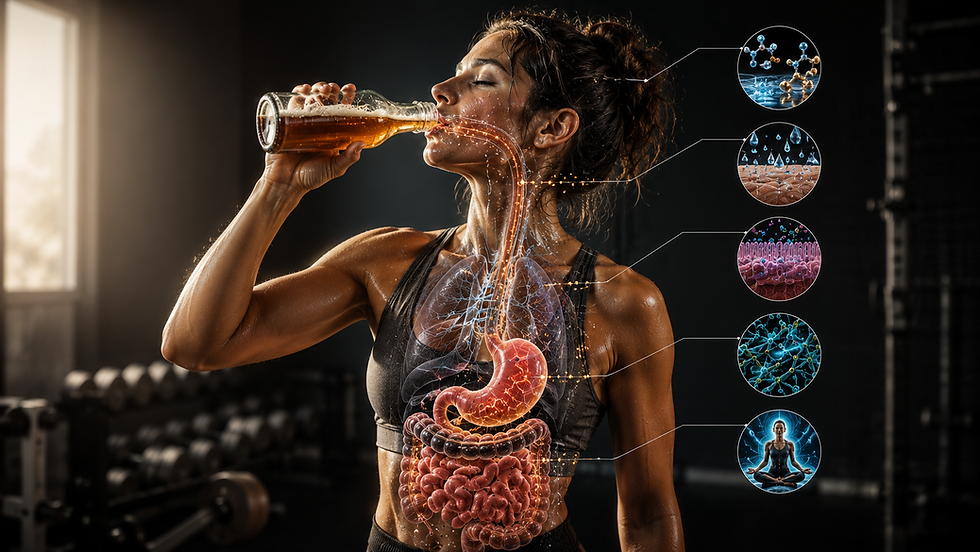
Walk into almost any grocery store today and you'll find an entire section dedicated to kombucha.
Colorful bottles, exotic flavors, labels promising probiotics, wellness, digestion support, and overall health.
For many people, kombucha has become a daily ritual. Some drink it for gut health, others enjoy it as a healthier alternative to soda, and increasingly, active individuals are beginning to wonder "Does kombucha have electrolytes?"
It's a reasonable question after all, hydration has become one of the biggest topics in human performance.
Athletes are paying more attention to fluid balance, office workers are becoming more aware of hydration's role in energy and cognition, travelers are looking for healthier beverage options, and wellness-minded consumers are trying to understand whether drinks like kombucha contribute to hydration or simply provide another trendy health claim.
The short answer is, Yes, kombucha contains naturally occurring electrolytes.
The longer answer is far more interesting.
Because while kombucha contains electrolytes, that doesn't necessarily mean it functions like a traditional electrolyte beverage.
That's why Human Performance HQ developed the BREW Protocol.
Understanding the difference can help you decide when kombucha is a great choice and when your body may need something more.
If you've already read our articles on Does Green Tea Have Electrolytes?, Electrolyte Drinks for Headaches, Electrolytes for Hot Yoga, or Do Electrolytes Make You Pee More?, you'll notice a common theme:
Hydration is about much more than simply drinking fluids. It's about matching your hydration strategy to the demands you're placing on your body, and that's where kombucha enters the conversation.
The Short Answer: Does Kombucha Have Electrolytes?
Yes.
Most kombucha contains small amounts of naturally occurring electrolytes.
Depending on the ingredients and brewing process, kombucha may contain:
Potassium
Magnesium
Calcium
Sodium (typically low amounts)
These minerals originate from:
Tea leaves
Added ingredients
Fermentation processes
However, the amount of electrolytes found in kombucha is generally much lower than what you'll find in dedicated hydration products designed specifically for electrolyte replacement.
This distinction matters.
Because having electrolytes and being an effective electrolyte replacement beverage are two different things.
What Is Kombucha?
Before we dive deeper into hydration, let's quickly discuss what kombucha actually is.
Kombucha is a fermented tea beverage produced using, Tea, Water, Sugar, and A SCOBY which stands for, Symbiotic Culture of Bacteria and Yeast
During fermentation, microorganisms consume much of the sugar and create a variety of compounds including:
Organic acids
Carbon dioxide
Trace vitamins
Probiotic organisms
Various metabolites
The result is a slightly tart, lightly carbonated beverage that has become popular within wellness communities.
While kombucha has existed for centuries, its popularity has exploded over the last decade as consumers have become increasingly interested in gut health and functional nutrition.
How Fermentation Changes the Beverage
One of the reasons kombucha generates so much interest is because fermentation fundamentally changes the original tea.
Fermentation is not simply preservation, it is transformation. During the fermentation process, microorganisms alter the chemical composition of the beverage.
This process can influence:
Flavor
Acidity
Nutrient availability
Microbial content
While kombucha isn't a significant source of most vitamins or minerals, fermentation creates a unique nutritional profile that differs substantially from regular tea.
This is one reason researchers continue studying fermented foods and beverages.
The fermentation process often creates properties that extend beyond the original ingredients.
Which Electrolytes Are Found in Kombucha?
Let's take a closer look at the electrolytes most commonly found in kombucha.
Potassium
Potassium is often the most notable electrolyte present.
Potassium plays a role in:
Muscle contractions
Fluid regulation
Nerve signaling
Cardiovascular function
Although kombucha typically contains less potassium than foods such as bananas, potatoes, or coconut water, it can contribute small amounts toward daily intake.
Magnesium
Some kombucha products contain trace amounts of magnesium.
Magnesium is involved in hundreds of physiological processes including:
Energy production
Muscle relaxation
Recovery
Nervous system function
Magnesium is also one of the most commonly under-consumed minerals in modern diets.
Calcium
Calcium is best known for its role in bone health, but it also contributes to:
Muscle contractions
Cellular signaling
Nerve communication
Small amounts may be present depending on the brewing process.
Sodium
Most kombucha products contain relatively low sodium levels.
This is one of the reasons kombucha should not be viewed as a primary electrolyte replacement beverage following significant sweat losses.
Sodium is typically the electrolyte lost in the greatest quantity during exercise.
Is Kombucha Actually Hydrating?
This is where things become interesting. Many people assume hydration is binary. Either something hydrates you or it doesn't.
The reality is more nuanced.
Kombucha contains:
Water
Electrolytes
Various dissolved compounds
Because of its fluid content alone, kombucha contributes to overall hydration.
Just as water, tea, milk, and Juice hydrate, kombucha also contributes to total daily fluid intake.
A better question is, how effective is kombucha compared to beverages specifically designed for hydration?
The answer depends entirely on the situation.
Kombucha Versus Everyday Hydration

For normal daily living, kombucha can absolutely contribute to hydration.
Imagine someone who:
Works in an office
Walks daily
Exercises moderately
Eats a balanced diet
For this individual, kombucha may serve as a perfectly reasonable beverage option. Its fluid content contributes to hydration. Its electrolyte content contributes small amounts of minerals, its probiotic content may support digestive health.
In this scenario, kombucha can be part of a healthy hydration strategy.
The challenge appears when people assume kombucha can replace purpose-built hydration beverages in high-demand situations.
Why Athletes Need to Think Differently
The hydration needs of athletes differ dramatically from the average person.
A marathon runner completing a two-hour training run can lose substantial amounts of water, sodium, and chloride through sweat.
A tactical athlete training outdoors in Florida heat may experience similar losses.
A hot yoga participant can lose surprising amounts of fluid during a single session.
In these situations, hydration isn't just about fluid intake, it's about electrolyte replacement, and this is where kombucha begins showing limitations.
While kombucha contains electrolytes, the concentrations are generally too low to replace what many athletes lose through sweat.
This doesn't mean kombucha is unhealthy, it means it serves a different purpose.
The Difference Between Hydration and Rehydration
One of the most important concepts in human performance is understanding the difference between hydration and rehydration.
Hydration refers to maintaining normal fluid balance. Rehydration refers to replacing fluids and electrolytes that have already been lost.
These are not identical goals.
Kombucha may contribute to hydration.
But after a long run, a military training event, a hot yoga session, and hours of outdoor labor… Replenishment needs often exceed what kombucha can reasonably provide.
This is why many sports nutrition experts recommend beverages containing more substantial sodium concentrations following prolonged sweat losses.
Kombucha and Gut Health: Why People Really Drink It

If we're being honest, most people aren't reaching for kombucha because they're trying to replace electrolytes.
They're reaching for it because of gut health.
The probiotics and fermentation-derived compounds found in kombucha are what drive much of its popularity.
Research continues exploring the relationship between gut health, immune function, metabolic health, and digestive comfort.
While kombucha should not be viewed as a miracle beverage, it can be part of a dietary pattern that supports overall wellness.
The important thing is recognizing what kombucha is, and what it isn't. It's a fermented beverage, not a sports drink, not a medical treatment, and definitely not a hydration solution for every circumstance.
Ariel Hernandez's Perspective: Stop Looking for the Perfect Drink
One of the most common patterns Ariel Hernandez sees in health and fitness is the search for the perfect beverage.
People want one drink that does everything: Hydrates, provides electrolytes, improves gut health, boosts recovery, enhances performance, and supports longevity.
The reality is that beverages, like tools, each have different jobs.
From Ariel's perspective, kombucha is a great example.
It can absolutely fit into a healthy lifestyle, contribute to hydration, and may support gut health, but expecting kombucha to perform the same role as an electrolyte beverage during a two-hour run or a military training exercise creates unrealistic expectations.
As Ariel often explains, "The best hydration strategy isn't finding one perfect drink. It's understanding what your body needs in a specific situation."
A desk worker, marathon runner, hot yoga participant, and tactical athlete all have different hydration demands.
The smartest approach isn't asking whether kombucha is good or bad.
It's asking whether kombucha matches the physiological demands you're placing on your body.
The BREW Protocol: A Practical Framework for Using Kombucha as Part of Your Hydration Strategy
One of the biggest mistakes people make with nutrition is turning every food or beverage into an all-or-nothing decision.
Kombucha is either a miracle drink, or it's useless, the reality is somewhere in the middle.
Kombucha can absolutely contribute to hydration and overall wellness, but its value depends on the context in which you're using it.
That's why Human Performance HQ developed the BREW Protocol.
Not as a marketing gimmick.
But as a practical way to determine whether kombucha fits your specific hydration and performance needs.
B — Balance Hydration Needs
The first question is simple, What are you asking kombucha to do?
If your goal is: General hydration, supporting healthy beverage choices, replacing sugary drinks, and incorporating fermented foods, kombucha can be a great option.
If your goal is:
Replacing 1,500 mg of sodium lost during a long run
Rehydrating after military training
Recovering from hours of sweating in the heat
kombucha may not be enough.
The beverage should match the demand.
R — Recognize Electrolyte Content
Kombucha contains electrolytes, but quantity matters.
Most kombucha products provide relatively small amounts of:
Potassium
Magnesium
Calcium
Sodium
Compared to dedicated electrolyte products, those amounts are generally modest.
Understanding this helps set realistic expectations.
E — Evaluate Exercise Demands
Hydration requirements increase as activity levels increase.
Someone walking around the neighborhood has different needs than:
A marathon runner
A cyclist
A tactical athlete
A hot yoga participant
Exercise changes the equation.
The greater the sweat losses, the greater the importance of targeted electrolyte replacement.
W — Watch Overall Recovery
Hydration is only one piece of recovery.
Recovery also depends on:
Nutrition
Sleep
Stress management
Training load
Energy intake
Kombucha may support part of the picture, but it should not be expected to solve recovery challenges by itself.
Kombucha vs Electrolyte Drinks: Which Is Better?
This is one of the most searched kombucha questions online.
The answer depends entirely on your goal.
Kombucha Is Better For:
Gut health support
Replacing soda
General wellness
Daily beverage variety
Fermented food intake
Electrolyte Drinks Are Better For:
Heavy sweating
Endurance events
Hot environments
Military training
Significant fluid losses
Rehydration after exercise
This isn't a competition, these beverages serve different functions.
A hammer isn't better than a screwdriver.
They're designed for different jobs, the same concept applies here.
Is Kombucha Good After a Workout?
The answer depends on the workout.
After a moderate gym session, kombucha can absolutely fit into a recovery routine, it provides:
Fluids
Some electrolytes
A refreshing beverage option
However, after prolonged exercise involving significant sweat losses, kombucha may not adequately replace:
Sodium
Chloride
Fluid losses
For example, A 20-minute strength workout and a three-hour trail run create vastly different hydration demands. Recovery strategies should reflect those differences.
Kombucha and Endurance Athletes
Endurance athletes often operate at the far end of the hydration spectrum.
Running, cycling, triathlon, and ultra-endurance events.
These activities can create substantial sweat losses.
Research from the American College of Sports Medicine continues emphasizing sodium replacement during prolonged exercise because sodium is the primary electrolyte lost in sweat.
While kombucha contains some electrolytes, it generally lacks the sodium concentrations needed for aggressive rehydration.
This means kombucha may be a pleasant recovery beverage, but it shouldn't be viewed as a primary electrolyte replacement strategy following prolonged endurance events.
Kombucha and Hot Yoga
If you've read our article Electrolytes for Hot Yoga, you already know how quickly sweat losses can accumulate during heated classes.
Many practitioners leave class lighter, dehydrated, and sodium depleted
In these situations, kombucha may provide fluids and enjoyment, Bbt it may not provide sufficient sodium to fully replace sweat losses.
This doesn't make kombucha bad, it just highlights the importance of matching the beverage to the physiological demand.
Kombucha for Travelers
Travel is one of the most overlooked hydration stressors.
Between:
Air travel
Reduced movement
Dry cabin air
Irregular meal schedules
many travelers become mildly dehydrated without realizing it.
Kombucha can be a useful option during travel because it provides:
Fluids
Variety
A potentially gut-friendly beverage alternative
However, travelers should still prioritize overall hydration rather than assuming kombucha alone will meet all fluid and electrolyte needs.
Does Kombucha Help Recovery?
Recovery means different things to different people.
For some, recovery means replacing fluids or restoring glycogen, and for others, it means supporting digestion.
Kombucha may contribute to recovery by:
Increasing fluid intake
Providing a satisfying beverage option
Supporting dietary variety
But recovery remains multifactorial.
Sleep, Nutrition, Hydration, and Training load All play significant roles.
No beverage can compensate for deficiencies in the bigger picture.
Kombucha Versus Sports Drinks
This comparison often appears online.
Let's simplify it.
Sports Drinks
designed primarily for:
Hydration
Electrolyte replacement
Exercise performance
Kombucha
designed primarily as:
A fermented beverage
A source of probiotics
A wellness-oriented drink
Both can be useful, but they solve different problems.
Trying to compare them directly often creates confusion.
Ariel Hernandez's Perspective: Hydration Is About Context
One of the biggest lessons Ariel Hernandez has learned while working in human performance is that context always matters.
The internet loves universal answers: Drink this, avoid that, this beverage is healthy, that beverage is unhealthy. Human physiology doesn't work that way.
Ariel has worked with:
Special operations personnel
Conventional military units
Endurance athletes
Active adults
And one thing becomes clear very quickly, Hydration needs are highly individualized.
The beverage that works perfectly for someone sitting at a desk may be completely inadequate for someone training in 95-degree Florida heat.
This is why Ariel encourages people to stop searching for perfect foods and drinks, instead, understand the role each one plays.
Kombucha can absolutely be part of a healthy lifestyle, it can contribute to hydration, contribute to dietary variety, and to overall wellness.
But it's not a magic beverage.
As Ariel often explains, "The best hydration strategy isn't built around a trendy drink. It's built around understanding what your body actually needs."
That mindset creates better decisions than any social media trend ever will.
Stay Connected With Human Performance HQ
Join the Human Performance HQ newsletter at the bottom of this page for science-backed insights on:
Hydration
Electrolytes
Recovery
Human performance
Nutrition
Longevity
Cognitive optimization
Get practical strategies delivered directly to your inbox.
Perform. Evolve. Achieve.
FAQs
Does kombucha have electrolytes?
Yes. Kombucha naturally contains small amounts of electrolytes such as potassium, magnesium, calcium, and sodium. The exact amounts vary based on ingredients and fermentation methods. However, the electrolyte content is generally much lower than dedicated sports hydration products.
Is kombucha hydrating?
Yes. Kombucha contributes to overall hydration because it contains water and electrolytes. For everyday hydration needs, it can be a useful beverage choice. However, it may not provide sufficient electrolyte replacement following heavy sweat losses.
Can kombucha replace electrolyte drinks?
In most athletic situations, no. While kombucha contains electrolytes, it typically does not provide enough sodium to replace what is lost during prolonged exercise, hot yoga, endurance training, or military activities. Dedicated electrolyte beverages are generally more effective for rehydration.
Is kombucha good after exercise?
It can be. Following light or moderate activity, kombucha may be a refreshing recovery beverage. After intense exercise with significant sweat losses, additional fluids and electrolytes may be necessary.
Does kombucha contain sodium?
Yes, but usually in relatively small amounts. Sodium levels vary between brands and recipes. Compared to sports drinks designed for electrolyte replacement, kombucha is generally not considered a high-sodium beverage.
Is kombucha healthier than sports drinks?
They serve different purposes. Kombucha may offer probiotic benefits and less added sugar than some traditional sports drinks. Sports drinks, however, are specifically formulated to support hydration and electrolyte replacement during exercise.
Does kombucha help with recovery?
Kombucha may support certain aspects of recovery by contributing fluids and supporting dietary variety. However, recovery depends on multiple factors including nutrition, sleep, hydration, and training load. Kombucha should be viewed as one component of a broader recovery strategy.
RESEARCH BACKED CITATIONS
Marsh, A. J., O'Sullivan, O., Hill, C., Ross, R. P., & Cotter, P. D. (2014). Sequence-based analysis of the bacterial and fungal compositions of multiple kombucha samples. Food Microbiology, 38, 171–178.https://www.sciencedirect.com/science/article/pii/S0740002013001513
Villarreal-Soto, S. A., Beaufort, S., Bouajila, J., Souchard, J. P., & Taillandier, P. (2018). Understanding kombucha tea fermentation: A review. Journal of Food Science, 83(3), 580–588.https://ift.onlinelibrary.wiley.com/doi/10.1111/1750-3841.14068
Laavanya, D., Shirkole, S., & Balasubramanian, P. (2021). Current challenges, applications and future perspectives of SCOBY cellulose of kombucha fermentation. Journal of Cleaner Production, 295, 126454.https://www.sciencedirect.com/science/article/pii/S0959652621003458
Marco, M. L., Sanders, M. E., Gänzle, M., Arrieta, M. C., Cotter, P. D., De Vuyst, L., Hill, C., Holzapfel, W., Lebeer, S., Reid, G., & Hutkins, R. (2021). The International Scientific Association for Probiotics and Prebiotics (ISAPP) statement on fermented foods. Nature Reviews Gastroenterology & Hepatology, 18(3), 196–208.https://www.nature.com/articles/s41575-020-00390-5
Sawka, M. N., Burke, L. M., Eichner, E. R., Maughan, R. J., Montain, S. J., & Stachenfeld, N. S. (2007). American College of Sports Medicine position stand: Exercise and fluid replacement. Medicine & Science in Sports & Exercise, 39(2), 377–390.https://journals.lww.com/acsm-msse/fulltext/2007/02000/exercise_and_fluid_replacement.22.aspx
Other Resources
Harvard T.H. Chan School of Public Health – Fermented Foods and Health https://nutritionsource.hsph.harvard.edu/fermented-foods/
National Center for Complementary and Integrative Health (NCCIH) – Kombucha Overview https://www.nccih.nih.gov/health/kombucha
Cleveland Clinic – What Is Kombucha? https://health.clevelandclinic.org/kombucha-benefits
Mayo Clinic – Probiotics and Digestive Health https://www.mayoclinic.org/healthy-lifestyle/consumer-health/in-depth/probiotics/art-20045220
International Scientific Association for Probiotics and Prebiotics (ISAPP) https://isappscience.org
American College of Sports Medicine Hydration Position Stand https://journals.lww.com/acsm-msse/fulltext/2007/02000/exercise_and_fluid_replacement.22.aspx


