
What Does Creatine Taste Like? The Truth About Flavor, Texture, and Quality
Updated: Oct 8
Most people spend a lot of time researching creatine before they ever take their first scoop.
They learn about:
Muscle growth
Strength gains
Recovery
Hydration
Cognitive performance
But then they run into a surprisingly simple question:
What does creatine taste like?

It's one of the most searched creatine questions online, and it's understandable.
If you're going to consume something every day, you probably want to know what you're getting yourself into.
Will it taste sweet?
Salty?
Bitter?
Chalky?
Will it ruin your morning coffee?
Does it taste better in juice?
And perhaps the most common concern,
Is creatine supposed to taste bad?
The good news is that most people are pleasantly surprised. Unlike many supplements that contain strong flavors, creatine monohydrate is actually quite mild. In fact, many first-time users are shocked by how little flavor it has.
The challenge isn't usually the taste, it's often the texture.
Understanding the difference can dramatically improve your supplementation experience.
If you've already read our Human Performance HQ articles on:
you've probably noticed a recurring theme:
The most effective supplement strategy isn't the most complicated one, it's the one you can consistently follow, and understanding what creatine tastes like can help remove another barrier to long-term consistency.
The Short Answer: What Does Creatine Taste Like?
Most unflavored creatine monohydrate has a taste that is best described as:
Mild
Neutral
Slightly chalky
Faintly bitter
Some people describe it as tasting almost like nothing. Others notice a subtle mineral-like flavor.
But compared to supplements such as:
Pre-workouts
Amino acid powders
Greens powders
creatine is generally considered very mild.
If you're expecting a strong or unpleasant taste, you're probably overestimating how noticeable it actually is.
In most cases, texture becomes more noticeable than flavor.
Does Creatine Have a Taste?
Technically, yes, but it's very subtle.
Pure creatine monohydrate does not contain:
Sweeteners
Flavoring agents
Artificial colors
As a result, it lacks the strong taste profile many people associate with sports supplements.
When mixed in water, most users report:
Very little flavor
A slight mineral taste
A mild chalk-like sensation
The exact experience varies from person to person because taste perception is highly individual.
What tastes completely neutral to one person may seem slightly bitter to another.
What Does Creatine Monohydrate Taste Like?

When people ask what creatine tastes like, they're usually referring to creatine monohydrate.
This is important because different forms of creatine can have different flavor characteristics.
Creatine monohydrate, the form used in most research, is generally described as:
Neutral
Mild
Slightly earthy
Slightly bitter
If you've ever tasted plain flour mixed into water, the sensation is somewhat similar, though typically less noticeable.
Most people quickly stop paying attention to the taste after a few days of use.
Why Some People Think Creatine Tastes Bad
This often comes down to expectations.
Many people assume creatine will taste terrible because:
It's a supplement
It's a white powder
It's associated with bodybuilding products
As a result, they anticipate an unpleasant experience.
Then they taste it and realize, it's actually pretty bland.
When people do complain about creatine, they're usually referring to one of two things: Texture or mixing quality, not flavor itself.
Why Creatine Feels Gritty
One of the most common complaints about creatine has nothing to do with taste.
It's the gritty texture.
You may notice:
Powder settling at the bottom of the glass
A sandy sensation
Small particles remaining after stirring
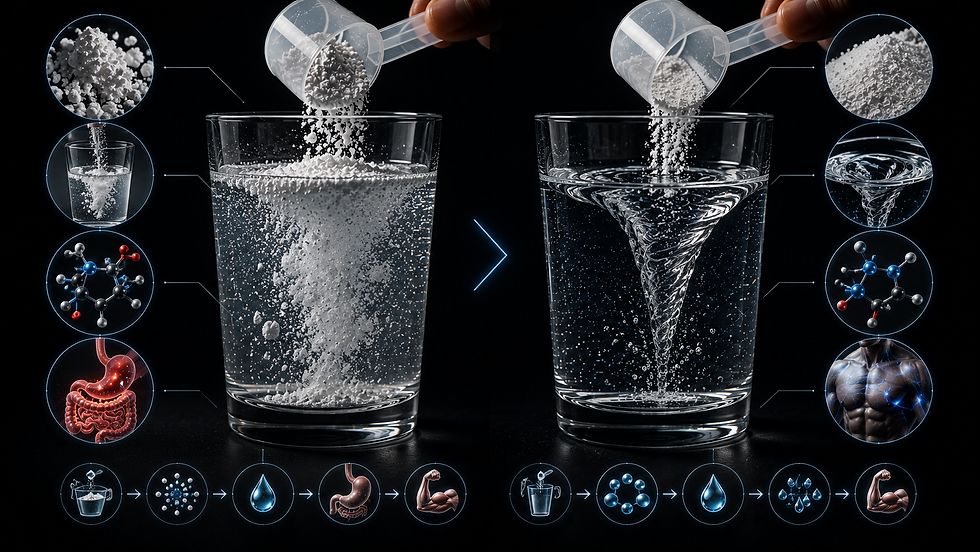
This happens because creatine monohydrate is not perfectly soluble in water.
In simple terms, It doesn't completely dissolve. This doesn't mean anything is wrong with the product. In fact, many high-quality creatine products still exhibit some degree of settling.
The gritty sensation is often normal.
Does Gritty Creatine Mean It's Low Quality?
No.
This is one of the biggest misconceptions surrounding creatine.
Many consumers assume, "If it doesn't fully dissolve, it must be low quality." That's not necessarily true. Even highly researched creatine monohydrate products may leave small particles behind. Creatine's natural solubility limitations contribute to this effect.
What matters more is:
Purity
Testing standards
Manufacturing quality
Not whether every particle disappears in water.
Why Different Creatine Brands Taste Different
Although pure creatine monohydrate should be relatively similar across reputable manufacturers, some users notice slight differences.
Several factors may contribute:
Micronization
Micronized creatine uses smaller particles.
This can improve mixing and alter mouthfeel.
Flavor Additives
Some brands include:
Flavoring agents
Sweeteners
Acids
These dramatically influence taste.
Manufacturing Quality
Higher-quality production methods may improve consistency and purity.
Individual Perception
Taste is subjective. What tastes neutral to one person may seem bitter to another.
Does Taste Indicate Creatine Quality?
Not necessarily.
This is an important concept because consumers often judge supplements based on sensory experience.
The reality is, taste tells you very little about effectiveness.
Some of the most researched creatine products in the world are:
Unflavored
Slightly gritty
Mild tasting
And yet they consistently produce excellent results.
Conversely, a supplement can taste amazing and still provide no performance benefit.
Performance outcomes matter more than flavor.
Why Flavored Creatine Tastes So Different
Flavored creatine products have become increasingly popular.
These products often contain:
Sweeteners
Natural flavors
Artificial flavors
Coloring agents
As a result, the taste difference can be dramatic.
Popular flavors include:
Fruit or tropical punch
Lemon lime
Watermelon
Blue raspberry
Rocket pop (or similar)
These products often appeal to individuals who dislike the texture or blandness of plain creatine.
However, the creatine itself isn't what's creating the flavor.
The added ingredients are.
Does Flavored Creatine Work the Same?
In most cases, yes.
The creatine molecule remains the same.
The primary difference is the addition of flavoring components.
When evaluating flavored creatine, focus on:
Total creatine dose
Product quality
Third-party testing
rather than simply choosing the best flavor.
A supplement should first be effective.
Then enjoyable.
Not the other way around.
What Does Creatine Taste Like in Water?
This is how most people consume creatine.
When mixed into water, creatine typically tastes:
Mild
Slightly mineral-like
Nearly neutral
The larger issue tends to be texture.
Many users notice:
Settling at the bottom
A chalk-like finish
Small undissolved particles
This is normal. Simply stirring again before the final sip often resolves the issue.
What Does Creatine Taste Like in Other Drinks?

One reason many people mix creatine into other beverages is to improve the overall experience.
For example:
Creatine in Milk
As discussed in our Creatine in Milk article, milk helps mask much of the texture while providing additional protein and calories.
Creatine in Hot Coffee
Coffee often masks nearly all of creatine's flavor, making it one of the easiest ways to consume it consistently.
Creatine in Juice
Juice can completely overpower creatine's mild taste, making it virtually undetectable.
This is one reason many people experiment with different mixing options until they find a routine they enjoy.
Ariel Hernandez's Perspective: Stop Overthinking the Taste
One thing Ariel Hernandez frequently sees in the human performance space is people becoming obsessed with details that have very little impact on results.
They spend hours researching:
What creatine tastes like
Which flavor is best
Which drink hides the taste
Meanwhile they're overlooking:
Training consistency
Recovery quality
Sleep habits
Daily supplementation
From Ariel's perspective, "Most people aren't going to fail with creatine because of the taste. They're going to fail because they stop taking it." And that's an important distinction.
The truth is that creatine tastes relatively mild, it's not delicious, but it's not terrible either.
For most people, the experience becomes almost irrelevant after a few days because the habit itself becomes automatic.
The best creatine isn't the one that tastes perfect.
It's the one you'll consistently take for months and years.
That's where the real performance benefits come from.
The TASTE Protocol: A Smarter Way to Evaluate Creatine Taste, Texture, and Quality
One of the biggest mistakes people make when buying creatine is assuming taste equals quality.
In reality, some of the most effective and research-backed creatine supplements on the market are:
Unflavored
Slightly gritty
Mild tasting
Meanwhile, some of the best-tasting products derive their flavor entirely from added sweeteners and flavoring agents.
That's why Human Performance HQ developed the TASTE Protocol. Not as a flavor rating system, but as a practical framework for understanding what actually matters when evaluating creatine.
T — Test Expectations
Many first-time users expect creatine to taste terrible. The reality is usually much less dramatic. Most creatine monohydrate products have a very mild flavor profile. Understanding this helps reduce unnecessary concerns before starting supplementation.
A — Assess Product Form
Different forms of creatine may produce slightly different sensory experiences.
For example:
Micronized creatine often feels smoother.
Flavored creatine tastes dramatically different.
Creatine gummies have completely different taste profiles.
Understanding the form helps explain the experience.
S — Stir Properly
Mixing technique influences both taste and texture.
Improper mixing often creates:
Settling
Gritty texture
Uneven distribution
Many complaints about creatine actually stem from mixing issues rather than flavor issues.
T — Think Beyond Flavor
The goal of creatine isn't to taste amazing.
The goal is to support:
Strength
Recovery
Performance
Muscle function
Cognitive performance
Flavor should never be the primary decision-making factor.
E — Establish Consistency
The best creatine is the one you'll actually take every day.
Whether that's:
Plain creatine
Flavored creatine
Creatine in coffee
Creatine in milk
consistency remains the priority.
7 Things That Affect What Creatine Tastes Like
Many people assume taste comes entirely from the creatine itself. In reality, several variables influence the overall experience.
1. Micronization
Micronized creatine uses smaller particles.
Smaller particles often create:
Better mixing
Less grittiness
Improved mouthfeel
This can make the supplement feel smoother even when the flavor remains unchanged.
2. Water Temperature
Creatine generally dissolves more effectively in warmer liquids.
This may reduce:
Settling
Texture issues
and create a smoother drinking experience.
3. Beverage Choice
The liquid matters.
Creatine tastes dramatically different when mixed into:
Water
Juice
Coffee
Milk
Smoothies
Many beverages effectively mask creatine's mild flavor.
4. Product Purity
High-quality creatine products tend to have more consistent particle size and manufacturing standards.
This may influence:
Texture
Mixing characteristics
User experience
5. Flavor Additives
Flavored creatine products often contain:
Sweeteners
Natural flavors
Artificial flavors
These ingredients influence taste far more than the creatine itself.
6. Storage Conditions
Exposure to:
Moisture
Heat
Improper storage
can influence product quality over time.
While taste changes are uncommon, proper storage remains important.
7. Individual Taste Perception
Taste is highly subjective. Two people can drink the exact same creatine and describe it completely differently. This is why user reviews often vary dramatically.
Flavored vs Unflavored Creatine
This is one of the most common questions among new creatine users.
Unflavored Creatine
Advantages:
Fewer ingredients
More versatile
Easier to mix into different beverages
Usually less expensive
Disadvantages:
Slightly bland
Texture may be more noticeable
Flavored Creatine
Advantages:
More enjoyable for some users
Better standalone drinking experience
Disadvantages:
Additional ingredients
May cost more
Less flexible for mixing
Both can be effective. The best choice depends on your personal preferences.
Best Ways to Mix Creatine
If you're concerned about taste, the easiest solution is often changing what you mix it with.
Creatine in Water
Simple and effective, and it is the most common option.
Creatine in Coffee
As discussed in our Creatine in Hot Coffee article, coffee masks most of creatine's flavor and can support habit formation.
Creatine in Milk
As covered in Creatine in Milk, milk helps reduce texture while providing protein and calories.
Creatine in Juice
Juice often makes creatine nearly impossible to detect. Many people find this to be the easiest option.
Creatine in Smoothies
Smoothies effectively eliminate both:
Flavor concerns
Texture concerns
making them a popular choice.
Does Bad-Tasting Creatine Mean It's Fake?
Not necessarily. This is one of the biggest misconceptions in the supplement world.
Creatine can taste:
Mild
Neutral
Slightly bitter
without indicating anything about quality.
The better indicators of quality include:
Third-party testing
Manufacturing standards
Brand reputation
Purity certifications
Taste alone is not a reliable quality assessment tool.
Does Creatine Expire?
Creatine is relatively stable when stored properly.
However, exposure to:
Moisture
Heat
Improper storage
can influence product quality over time. Always follow manufacturer guidelines and check expiration dates. Properly stored creatine often maintains quality for extended periods.
Why Creatine Taste Doesn't Matter as Much as People Think
One reason this keyword performs so well is because many people are nervous about starting supplementation.
They're looking for reassurance.
The reality is that creatine's flavor profile is one of the least important aspects of supplementation.
Compared to:
Training quality
Recovery
Nutrition
Hydration
Sleep
taste contributes almost nothing to performance outcomes.
Yet many consumers spend more time researching flavor than effectiveness.
Ariel Hernandez's Perspective: Focus on Results, Not Flavor
One thing Ariel Hernandez frequently reminds athletes and active adults is that supplements exist to support performance, not entertainment. That doesn't mean taste doesn't matter. Enjoyable routines improve consistency. It's important to keep priorities in order.
From Ariel's perspective, "People often spend more time researching what creatine tastes like than they spend researching what creatine actually does."
The irony is that most people stop noticing the flavor entirely after a week or two.
The habit takes over. The routine becomes automatic, and that's where the benefits begin, because the real value of creatine isn't found in the taste.
It's found in what happens after months and years of consistent use.
Why Single Serve Creatine and Electrolyte Packets Like HPSTIX Help Improve The Consumer Experience of Intaking Creatine
As discussed in:
the effectiveness of creatine often depends on creating a routine that supports consistency. Hydration plays a major role in that process, and if it doesn't taste good, people won't use it!
HPSTIX was designed around the idea that a tasty hydration solution should support:
Physical performance
Cognitive performance
Recovery
Readiness
Stay Connected With Human Performance HQ
Join the Human Performance HQ newsletter at the bottom of this page for evidence-based education on:
Creatine
Hydration
Recovery
Human performance
Nutrition
Cognitive optimization
Longevity
Get practical, science-backed strategies delivered directly to your inbox.
Perform. Evolve. Achieve.
FAQs
What does creatine taste like?
Most unflavored creatine monohydrate has a very mild taste that is often described as neutral, slightly chalky, or faintly bitter. The flavor is generally much less noticeable than many people expect. For most users, texture becomes more noticeable than taste.
Does creatine have a taste?
Yes, but it is usually subtle. Pure creatine monohydrate lacks sweeteners and flavoring agents, resulting in a relatively bland taste profile. Many people describe it as nearly flavorless.
Is creatine supposed to taste bad?
Not necessarily. High-quality creatine can still taste mildly bitter or chalky, and this does not indicate poor quality. Most users find the taste manageable, especially when mixed with other beverages.
Why does creatine taste gritty?
The gritty sensation comes from incomplete dissolution rather than flavor. Creatine monohydrate is not perfectly soluble in water, so some particles often remain suspended or settle at the bottom of the glass.
Does flavored creatine work the same as unflavored creatine?
In most cases, yes. The primary difference is the addition of sweeteners and flavoring agents. The effectiveness depends on the creatine dose and product quality rather than the flavor.
Can I mix creatine with juice?
Absolutely. Juice is one of the easiest ways to mask creatine's mild taste and texture. Many users find creatine virtually undetectable when mixed into fruit juice.
Does taste indicate creatine quality?
No. Taste is not a reliable measure of effectiveness or purity. Third-party testing, manufacturing standards, and ingredient transparency provide far better indicators of quality.
RESEARCH BACKED CITATIONS
Kreider, R. B., Kalman, D. S., Antonio, J., Ziegenfuss, T. N., Wildman, R., Collins, R., Candow, D. G., Kleiner, S. M., Almada, A. L., & Lopez, H. L. (2017). International Society of Sports Nutrition position stand: Safety and efficacy of creatine supplementation in exercise, sport, and medicine. Journal of the International Society of Sports Nutrition, 14(18). https://jissn.biomedcentral.com/articles/10.1186/s12970-017-0173-z
Antonio, J., Candow, D. G., Forbes, S. C., Gualano, B., Jagim, A. R., Kreider, R. B., Rawson, E. S., Smith-Ryan, A. E., VanDusseldorp, T. A., Willoughby, D. S., & Ziegenfuss, T. N. (2021). Common questions and misconceptions about creatine supplementation: What does the scientific evidence really show? Journal of the International Society of Sports Nutrition, 18(13). https://jissn.biomedcentral.com/articles/10.1186/s12970-021-00412-w
Buford, T. W., Kreider, R. B., Stout, J. R., Greenwood, M., Campbell, B., Spano, M., Ziegenfuss, T., Lopez, H., Landis, J., Antonio, J., & International Society of Sports Nutrition. (2007). International Society of Sports Nutrition position stand: Creatine supplementation and exercise. Journal of the International Society of Sports Nutrition, 4(6). https://jissn.biomedcentral.com/articles/10.1186/1550-2783-4-6
Jagim, A. R., Kerksick, C. M., & Campbell, B. I. (2024). Creatine supplementation and human performance: Current evidence and future directions. Nutrients, 16(4), 526. https://www.mdpi.com/2072-6643/16/4/526
Kreider, R. B., Melton, C., Greenwood, M., Rasmussen, C., Lundberg, J., Earnest, C., Almada, A. L., & Milnor, P. (2003). Effects of oral creatine supplementation on body composition and performance: A meta-analysis. Medicine & Science in Sports & Exercise, 35(Supplement), S178. https://journals.lww.com/acsm-msse/pages/default.aspx
Other Resources
International Society of Sports Nutrition Position Stand on Creatine https://jissn.biomedcentral.com/articles/10.1186/s12970-017-0173-z
Common Questions and Misconceptions About Creatine Supplementation https://jissn.biomedcentral.com/articles/10.1186/s12970-021-00412-w
National Institutes of Health Office of Dietary Supplements https://ods.od.nih.gov
Creapure® Quality Standards https://www.creapure.com
NSF Certified for Sport https://www.nsfsport.com
Cleveland Clinic – Creatine Benefits and Safety https://my.clevelandclinic.org/health/treatments/17674-creatine


