
Creatine and Pilates: The Missing Link Between Strength, Recovery, and Mind-Body Performance
Updated: Oct 8

Walk into almost any Pilates studio and you'll hear conversations about posture.
Core strength.
Mobility.
Flexibility.
Balance.
Mind-body connection.
What you probably won't hear much discussion about is creatine.
For decades, creatine has been associated with bodybuilders, football players, powerlifters, and gym culture. The supplement has built a reputation as something reserved for people chasing bigger muscles and heavier lifts.
Pilates practitioners often view themselves differently.
They focus on movement quality rather than muscle size. Control rather than intensity. Precision rather than brute force, and as a result, many Pilates enthusiasts assume creatine has little relevance to their training.
That assumption may be costing them performance benefits.
Because while creatine can support muscle growth, that is only one piece of the story.
At its core, creatine is an energy molecule and every aspect of Pilates, from maintaining posture and controlling movement to balancing on a reformer and sustaining muscular endurance, requires energy.
The conversation isn't really about creatine and bodybuilding.
It's about creatine and human performance.
That’s why we created The ALIGN Protocol.
If you've already read our articles on Benefits of Taking Creatine Before Bed, Why You Feel Weak During Workouts, or What Is Human Performance?, you've probably noticed a recurring theme:
The body doesn't care what type of exercise you're performing.
Physiology still applies.
Pilates may look different than a traditional strength workout.
But the systems driving performance remain remarkably similar.
Why Pilates Practitioners Are Athletes
One of the biggest misconceptions in fitness is the belief that athleticism only exists in traditional sports.
Many people hear the word athlete and immediately picture:
Olympic competitors
Professional athletes
Marathon runners
Powerlifters
Yet athleticism is simply the ability to perform physical tasks efficiently.
By that definition, Pilates practitioners are absolutely athletes.
A challenging Pilates session requires:
Muscular endurance
Core stability
Balance
Neuromuscular coordination
Postural control
Movement precision
Unlike traditional strength training, Pilates often places individuals under prolonged tension.
Small stabilizing muscles are constantly active.
The nervous system continuously processes movement information.
The body must coordinate multiple systems simultaneously.
This isn't passive exercise.
It's high-level movement training.
And movement training requires energy.
The Energy System Nobody Talks About
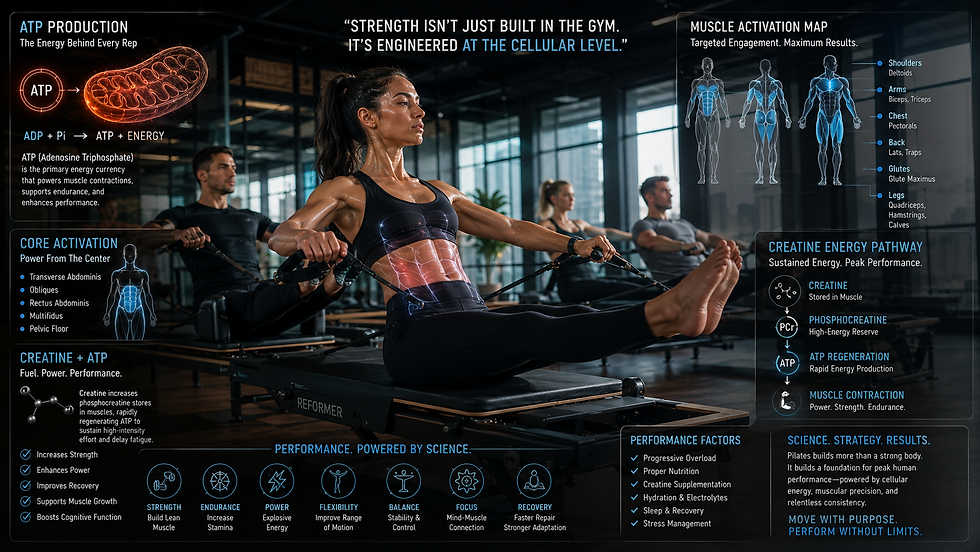
Most discussions about Pilates focus on muscles.
Very few focus on energy production. Yet energy production is what makes movement possible. Every movement in the body relies on ATP, Adenosine triphosphate.
ATP is the body's primary energy currency.
Without ATP:
Muscles cannot contract.
Nerves cannot communicate.
Movement cannot occur.
Balance cannot be maintained.
The challenge is that ATP stores are extremely limited.
The body only stores enough ATP for a few seconds of high-demand activity.
To solve this problem, the body uses several systems to regenerate ATP.
One of the fastest and most powerful systems is the phosphocreatine system.
This is where creatine enters the picture.
Research from the International Society of Sports Nutrition (ISSN) identifies creatine as one of the most extensively researched and effective supplements for supporting ATP regeneration, exercise performance, recovery, and lean mass development (Kreider et al., 2017).
Most people associate this system with sprinting or heavy lifting.
But ATP turnover occurs during Pilates too.
Every controlled movement.
Every isometric hold.
Every stabilization exercise.
Every reformer sequence.
Energy is constantly being used and regenerated.
Creatine Is Not a Muscle Supplement
One of the biggest marketing mistakes in the supplement industry is how creatine has been positioned.
The public sees creatine as a muscle supplement. Physiology sees creatine differently. Creatine is an energy support supplement. Its primary role is helping regenerate ATP.
That ATP supports:
Muscular contraction
Nervous system activity
Cognitive performance
Recovery processes
Cellular function
Muscle growth is simply one downstream effect.
This distinction matters because Pilates practitioners often prioritize outcomes that extend beyond muscle size.
They want:
Better movement
Improved balance
Greater body awareness
Enhanced recovery
Healthy aging
Sustainable performance
All of those systems rely on energy.
And energy is exactly where creatine operates.
Why Stability Requires More Energy Than You Think
One of the most fascinating aspects of Pilates is how much energy is required to remain stable.
Most people assume movement requires energy.
They rarely consider the energetic demands of resisting movement.
Imagine holding a plank. Maintaining perfect posture. Balancing on a reformer carriage. Performing a slow, controlled single-leg exercise.
The body must continuously recruit stabilizing muscles to maintain position.
Research in exercise physiology demonstrates that stabilization tasks often create significant neuromuscular demands because the nervous system is constantly making micro-adjustments.
This requires communication between the brain, the spinal cord, peripheral nerves, muscular tissue, and every one of those processes depends on ATP.
Pilates practitioners spend a tremendous amount of time in these environments.
Which means the conversation around creatine may be more relevant than many realize.
The Brain Benefits May Be Just as Important
One reason Pilates continues growing in popularity is its emphasis on mindfulness and body awareness.
Pilates isn't simply physical.
It's neurological.
Participants must:
Focus attention
Coordinate movement
Control breathing
Maintain balance
Execute precise movement patterns
The brain is deeply involved.
This is where creatine research becomes particularly interesting.
Research by Rawson and Venezia suggests creatine may support cognitive performance, particularly during periods of stress, sleep deprivation, or elevated metabolic demand.
Similarly, a systematic review by Avgerinos and colleagues found evidence that creatine supplementation may support memory and certain cognitive tasks in specific populations.
Why?
Because the brain consumes enormous amounts of energy.
Although it represents only about 2% of body weight, it consumes roughly 20% of the body's energy at rest.
This means creatine isn't simply supporting muscles. It's supporting one of the most energy-demanding organs in the body. For Pilates practitioners who value focus, awareness, and mind-body connection, this becomes a fascinating area of discussion.
Why Women May Benefit More Than They Think
This is perhaps the most overlooked aspect of the creatine conversation.
Many Pilates participants are women.
Historically, supplement marketing has largely focused creatine toward men.
Modern research tells a different story.
Research published in Nutrients and Frontiers in Nutrition increasingly suggests women may derive meaningful benefits from creatine supplementation across multiple stages of life.
These potential benefits include support for Strength, Lean mass preservation, Recovery, Cognitive function, Healthy aging
This becomes especially relevant during:
Perimenopause
Menopause
Aging
Because changes in hormone levels can influence muscle mass, recovery, and performance.
Creatine may help support some of these physiological systems. Importantly, this conversation extends far beyond aesthetics. It becomes a discussion about maintaining function and performance throughout life.
Which aligns perfectly with the philosophy behind Pilates.
Pilates, Healthy Aging, and Longevity

One reason Pilates remains popular across age groups is its accessibility.
Many people continue practicing well into their 50s, 60s, and beyond.
The goals often shift over time.
Instead of pursuing performance at all costs, individuals become more interested in:
Longevity
Independence
Mobility
Strength
Balance
Quality of life
This is where creatine research becomes particularly compelling.
Research by Candow and colleagues has explored creatine's role in supporting healthy aging, muscle preservation, and functional performance.
The emerging evidence suggests creatine may be one of the most valuable supplements available for maintaining physical function as we age.
From a human performance perspective, longevity is not simply about living longer.
It's about maintaining capability.
Pilates and creatine may actually share this common objective.
Ariel Hernandez's Perspective: Movement Quality Still Requires Energy
If you were to ask Ariel Hernandez about creatine and Pilates, he'd likely tell you that the fitness industry often creates unnecessary divisions.
People categorize exercise into separate boxes.
Strength training.
Pilates.
Yoga.
Running.
Functional fitness.
But physiology doesn't care about categories. The body sees demands.
From Ariel's perspective, one of the biggest misconceptions is that Pilates practitioners don't need the same physiological support systems as traditional athletes.
In reality, Pilates requires:
Energy production
Recovery
Neuromuscular control
Muscular endurance
Cognitive engagement
The body still relies on ATP. The nervous system still relies on ATP. Recovery still relies on ATP. Whether you're deadlifting 400 pounds or holding a perfectly controlled Pilates movement, your body is still operating on the same biological systems.
The exercise changes.
The physiology does not.
Why Recovery Is the Missing Piece
One of the reasons Pilates practitioners may overlook creatine is because they associate it exclusively with performance.
Yet recovery may be where creatine becomes most interesting.
Every training adaptation occurs during recovery.
Not during the workout itself.
This includes:
Muscular repair
Tissue remodeling
Nervous system recovery
Performance adaptation
Research continues to demonstrate that creatine may help support recovery processes by improving cellular energy availability.
For individuals practicing Pilates several times per week, recovery quality often determines long-term progress.
And that is where the conversation begins shifting from supplementation to performance optimization.
The ALIGN Protocol: A Human Performance Framework for Creatine and Pilates
One of the reasons creatine is often misunderstood is because people focus on the supplement instead of the outcome.
The question shouldn't be "Should Pilates practitioners take creatine?"
The better question is "Can creatine support the physiological systems Pilates practitioners are trying to improve?"
When viewed through that lens, the conversation becomes much more interesting.
Because Pilates is ultimately about improving human movement.
Better movement requires:
Energy
Recovery
Stability
Strength
Coordination
Focus
These are precisely the systems creatine may help support.
This is why Human Performance HQ recommends the ALIGN Protocol.
A practical framework for integrating creatine into a Pilates-focused lifestyle.
A — Augment Cellular Energy
Every Pilates movement requires ATP.
Whether you're performing:
Hundreds
Teasers
Long planks
Reformer sequences
Stability exercises
the body is constantly regenerating energy. Creatine helps support phosphocreatine stores, allowing ATP to be regenerated more efficiently during demanding movements.
The goal is not necessarily to make Pilates easier.
The goal is supporting the energy systems that make movement possible.
L — Leverage Consistency
One of the biggest misconceptions about creatine is that timing is everything.
Research consistently shows that daily consistency matters more than perfect timing.
Taking creatine every day is generally more important than obsessing over whether it is consumed:
Before Pilates
After Pilates
In the morning
At night
Consistency drives saturation. Saturation drives results.
I — Improve Recovery
Recovery is where adaptation occurs.
Pilates practitioners often focus heavily on training quality while overlooking recovery quality.
Creatine may help support recovery by improving cellular energy availability and helping the body adapt to training demands.
Recovery is where progress happens.
G — Generate Strength and Stability
Strength is not limited to heavy lifting.
Pilates develops:
Postural strength
Core strength
Stability strength
Movement strength
These qualities often require prolonged muscular activation.
Supporting muscular performance can help support long-term training consistency.
N — Nourish Brain Performance
Pilates is as much neurological as it is physical.
Body awareness.
Breathing.
Movement control.
Balance.
Coordination.
These all require cognitive engagement. Emerging research suggests creatine may support certain aspects of cognitive performance and brain energetics.
This becomes particularly relevant for individuals who value the mind-body connection that Pilates encourages.
Reformer Pilates vs Mat Pilates: Does It Matter?
One question rarely discussed is whether creatine benefits differ between reformer Pilates and mat Pilates.
The reality is that both styles create meaningful physiological demands.
Reformer Pilates often introduces:
Increased resistance
Greater instability
Longer time under tension
Higher muscular endurance demands
Mat Pilates frequently emphasizes:
Core control
Bodyweight resistance
Movement precision
Stability
Both require ATP, recovery, and neuromuscular coordination.
This means the physiological rationale for creatine remains largely the same.
The modality changes.
The energy systems do not.
Creatine and Recovery: The Underrated Benefit
Most supplement discussions focus on performance.
Pilates practitioners may benefit more from the recovery conversation.
Research published in the Journal of the International Society of Sports Nutrition continues to support creatine's role in supporting recovery and training adaptation.
Why does this matter?
Because many Pilates enthusiasts:
Attend multiple sessions weekly
Combine Pilates with strength training
Walk extensively
Run
Cycle
Participate in recreational sports
Their bodies are often balancing multiple training demands simultaneously.
Recovery becomes a limiting factor.
Not motivation.
Not effort.
Recovery.
Supporting recovery can improve consistency.
Consistency drives long-term results.
Why Creatine Is Becoming More Popular Among Women
One of the most significant trends in sports nutrition is the growing recognition that creatine is not simply a supplement for men.
Women are increasingly exploring creatine for:
Strength
Recovery
Body composition
Cognitive performance
Healthy aging
Research published in Nutrients suggests women may experience unique benefits from creatine supplementation across various stages of life.
This becomes especially relevant because many Pilates communities include women who prioritize Longevity, Function, Energy, and Mobility, rather than traditional bodybuilding goals.
The science is evolving, and the conversation is evolving with it.
Perimenopause, Menopause, and Pilates
This may be one of the most valuable sections of the entire article.
Many women discover Pilates during:
Perimenopause
Menopause
Midlife
Often because they're seeking:
Joint-friendly exercise
Core strength
Balance training
Mobility
Long-term health
Research increasingly suggests creatine may support Muscle preservation, Strength maintenance, Functional performance, and Cognitive health during aging.
This does not mean creatine is a miracle solution, but it does mean that women pursuing healthy aging should not automatically dismiss it because of outdated bodybuilding stereotypes.
The physiology deserves consideration.
Should You Take Creatine Before or After Pilates?
One of the most common questions online is "When should I take creatine for Pilates?"
The evidence remains remarkably consistent.
The exact timing appears less important than total daily intake and long-term consistency.
That said, many practitioners prefer:
Before Pilates
Because it becomes part of a pre-session routine.
Others prefer:
After Pilates
Because it aligns with their recovery routine.
Some take it:
Before Bed
As discussed in our article on Benefits of Taking Creatine Before Bed.
The best time is often the time you'll consistently remember.
Creatine, Hydration, and Pilates
No Human Performance HQ discussion would be complete without hydration.
One of the most persistent myths surrounding creatine is that it causes dehydration.
Research does not support this claim.
In fact, creatine may support intracellular hydration.
This is important because hydration influences:
Recovery
Performance
Energy
Tissue quality
Pilates practitioners frequently value movement quality and body awareness.
Hydration influences both.
This is one reason many individuals combine creatine supplementation with improved hydration strategies.
If you've read:
Best Hydration Strategy for Workouts
Hydration for Recovery
How Hydration Affects Physical Performance
you already understand that hydration is foundational to human performance.
Creatine complements that foundation.
The Top 7 Reasons Pilates Practitioners Consider Creatine
While everyone's goals differ, common reasons include:
Supporting recovery between sessions.
Improving muscular endurance.
Supporting healthy aging.
Enhancing strength development.
Supporting cognitive performance.
Improving overall training consistency.
Complementing a broader human performance strategy.
The goal is not becoming a bodybuilder.
The goal is becoming more capable.
Stay Connected With Human Performance HQ
Join the Human Performance HQ newsletter at the bottom of this page for science-backed insights on hydration, recovery, performance nutrition, longevity, cognitive performance, and human performance optimization.
Get evidence-based strategies delivered directly to your inbox.
Perform. Evolve. Achieve.
FAQs
Is creatine good for Pilates?
Yes. While creatine is often associated with strength sports, it supports ATP production, which powers all movement. Pilates relies heavily on muscular endurance, neuromuscular control, stability, and recovery, all systems that require energy. This makes creatine relevant for many Pilates practitioners, even if muscle growth is not their primary goal.
Should Pilates instructors take creatine?
Pilates instructors often spend hours demonstrating movements, maintaining postures, and teaching multiple classes per week. These activities create cumulative physical demands that require recovery and energy support. Creatine may help support training consistency, recovery, and overall performance.
Does creatine help core strength?
Creatine does not directly target core muscles, but it supports ATP regeneration, which can improve training capacity and muscular performance. Since Pilates heavily emphasizes core engagement, improved training quality may contribute to better core strength over time.
Can women take creatine for Pilates?
Absolutely. Modern research increasingly supports creatine supplementation for women across multiple life stages. Potential benefits may include support for strength, recovery, healthy aging, and cognitive performance, making it highly relevant to many Pilates practitioners.
Will creatine make me bulky?
This is one of the most common myths surrounding creatine. Creatine supports cellular hydration and performance, but it does not automatically cause excessive muscle growth. Building significant muscle mass requires specific training and nutrition strategies that extend far beyond simply taking creatine.
Is creatine useful for healthy aging?
Research suggests creatine may help support muscle preservation, functional performance, and cognitive health as individuals age. This makes it one of the most promising supplements for people interested in longevity and maintaining independence later in life.
Should I take creatine before or after Pilates?
Current evidence suggests timing is less important than consistency. Whether you take creatine before Pilates, after Pilates, or at another time of day, maintaining regular intake is generally the most important factor for achieving full saturation and potential benefits.
RESEARCH BACKED CITATIONS
Avgerinos, K. I., Spyrou, N., Bougioukas, K. I., & Kapogiannis, D. (2018). Effects of creatine supplementation on cognitive function of healthy individuals: A systematic review of randomized controlled trials. Experimental Gerontology, 108, 166–173.https://www.sciencedirect.com/science/article/abs/pii/S053155651730946X
Candow, D. G., Forbes, S. C., Chilibeck, P. D., Cornish, S. M., Antonio, J., & Kreider, R. B. (2019). Variables influencing the effectiveness of creatine supplementation as a therapeutic intervention for sarcopenia. Frontiers in Nutrition, 6, 124.https://www.frontiersin.org/articles/10.3389/fnut.2019.00124/full
Kreider, R. B., Kalman, D. S., Antonio, J., Ziegenfuss, T. N., Wildman, R., Collins, R., Candow, D. G., Kleiner, S. M., Almada, A. L., & Lopez, H. L. (2017). International Society of Sports Nutrition position stand: Safety and efficacy of creatine supplementation in exercise, sport, and medicine. Journal of the International Society of Sports Nutrition, 14(18).https://jissn.biomedcentral.com/articles/10.1186/s12970-017-0173-z
Rawson, E. S., & Venezia, A. C. (2011). Use of creatine in the elderly and evidence for effects on cognitive function in young and old. Amino Acids, 40(5), 1349–1362.https://link.springer.com/article/10.1007/s00726-011-0855-3
Smith-Ryan, A. E., Cabre, H. E., Eckerson, J. M., & Candow, D. G. (2021). Creatine supplementation in women's health: A lifespan perspective. Nutrients, 13(3), 877.https://www.mdpi.com/2072-6643/13/3/877
Other Resources
Experimental Gerontology – Effects of Creatine Supplementation on Cognitive Functionhttps://www.sciencedirect.com/science/article/abs/pii/S053155651730946X
Frontiers in Nutrition – Creatine Supplementation and Sarcopeniahttps://www.frontiersin.org/articles/10.3389/fnut.2019.00124/full
International Society of Sports Nutrition Position Stand: Safety and Efficacy of Creatine Supplementationhttps://jissn.biomedcentral.com/articles/10.1186/s12970-017-0173-z
Amino Acids – Use of Creatine in the Elderly and Cognitive Functionhttps://link.springer.com/article/10.1007/s00726-011-0855-3
Nutrients – Creatine Supplementation in Women's Healthhttps://www.mdpi.com/2072-6643/13/3/877
Alzheimer's Association – Brain Health Resourceshttps://www.alz.org
National Institute on Aging – Cognitive Health and Older Adultshttps://www.nia.nih.gov/health/cognitive-health-and-older-adults
NIH Office of Dietary Supplements – Exercise and Athletic Performancehttps://ods.od.nih.gov/factsheets/ExerciseAndAthleticPerformance-HealthProfessional/


