
Do Electrolytes Help Migraines?
Updated: Oct 8
Understanding the Hydration-Brain Connection

A migraine can ruin an entire day. Sometimes it arrives with warning signs. Other times it seems to appear out of nowhere. One minute you're productive, focused, and energized.
The next, you're dealing with throbbing pain, sensitivity to light, difficulty concentrating, nausea, or a level of fatigue that makes even simple tasks feel overwhelming.
If you've ever experienced migraines, you've probably searched for answers.
Was it stress?
Lack of sleep?
A food trigger?
Too much caffeine?
Not enough caffeine?
Hormones?
Weather changes?
The reality is that migraines are complex neurological events influenced by multiple factors. There is rarely a single cause, but there is one trigger that often receives less attention than it deserves hydration.
More specifically, the relationship between hydration, electrolyte balance, and brain function.
This leads to a question many people ask "Do electrolytes help migraines?"
The short answer is that electrolytes are not a cure for migraines.
However, hydration status and electrolyte balance may influence migraine susceptibility in some individuals, particularly when dehydration, heat exposure, exercise, travel, poor sleep, or prolonged sweating are involved.
That's why we created The BRAIN Protocol.
Understanding that connection requires looking beyond sports drinks and into the physiology of the brain itself.
Because migraines aren't simply headaches.
And hydration isn't simply about drinking water.
Migraines Are Different Than Headaches
Before discussing electrolytes, it's important to understand that migraines are not simply "bad headaches."
Migraines are neurological events involving changes in brain activity, nervous system signaling, blood vessel function, and sensory processing.
According to the American Migraine Foundation, migraines may involve symptoms such as:
Moderate to severe head pain
Light sensitivity
Sound sensitivity
Nausea
Visual disturbances
Cognitive impairment
Fatigue
This distinction matters.
Not every headache is a migraine, and not every migraine is caused by dehydration.
However, dehydration is a commonly reported trigger among migraine sufferers.
That creates an interesting question.
Why would hydration influence the brain so strongly?
The Brain Is Extremely Sensitive to Hydration Status

One of the most fascinating facts about human physiology is how dependent the brain is on water.
The brain is approximately 73% water.
Even small changes in hydration status can influence:
Blood flow
Temperature regulation
Neurotransmitter activity
Cognitive performance
Mood
Perceived fatigue
Research published in Nutrients has repeatedly demonstrated that mild dehydration can impair attention, working memory, mood, and cognitive performance.
This doesn't mean dehydration causes migraines in everyone, but it helps explain why dehydration can become a meaningful trigger for some individuals.
The brain operates within a carefully regulated environment. When hydration status changes, that environment changes as well. For susceptible individuals, that change may contribute to headache or migraine symptoms.
Why Water Alone Doesn't Tell the Whole Story
Most people think hydration means drinking water. Water is certainly important, but hydration is not simply fluid intake.
Hydration is fluid regulation, and this is where electrolytes enter the conversation.
Electrolytes help regulate:
Fluid balance
Nerve signaling
Blood pressure
Cellular communication
Muscular contraction
The primary electrolytes include Sodium, Potassium, Magnesium, Calcium, and Chloride.
Without adequate electrolyte balance, water cannot be utilized as effectively throughout the body. This includes the brain. Think of electrolytes as traffic controllers helping direct fluid movement and cellular communication. Water is the passenger. Electrolytes help determine where it goes.
This is one reason some people report improvements in hydration-related headaches when electrolyte intake improves.
The issue may not have been water alone. It may have been fluid regulation.
Why Dehydration Is a Common Migraine Trigger
One of the most consistently reported migraine triggers is dehydration.
Research published in Headache: The Journal of Head and Face Pain has identified dehydration as a frequent trigger among migraine sufferers.
The mechanism is likely multifactorial.
Potential contributors include:
Reduced blood volume
Changes in cerebral blood flow
Increased physiological stress
Altered electrolyte balance
Changes in nervous system signaling
From a human performance perspective, dehydration creates strain.
The body must work harder to maintain normal function.
The brain is no exception.
This is one reason headaches often appear alongside other symptoms such as:
Fatigue
Brain fog
Reduced concentration
Irritability
Poor exercise performance
The migraine may feel like the primary issue.
But physiology is often influencing multiple systems simultaneously.
Why Some People Get Headaches After Exercise
One of the most common questions in human performance settings is "Why do I get headaches after working out?"
The answer isn't always dehydration.
But dehydration frequently contributes.
Exercise increases:
Sweat losses
Fluid requirements
Electrolyte losses
Cardiovascular demand
If fluids and electrolytes are not adequately replaced, headache symptoms may develop afterward.
This becomes especially relevant for:
Endurance athletes
Runners
Cyclists
CrossFit athletes
Military personnel
Hot yoga practitioners
If you've read our articles on Hydration for Endurance Athletes, Best Hydration Strategy for Workouts, or Electrolytes for Hot Yoga, you've already seen how sweat losses can influence performance and recovery.
The same physiology may influence headache susceptibility as well.
The Magnesium-Migraine Connection
Among all electrolytes, magnesium deserves special attention.
Unlike sodium, which is primarily discussed in hydration conversations, magnesium has received significant attention within migraine research.
According to the American Migraine Foundation magnesium resource center, some evidence suggests magnesium may play a role in migraine prevention for certain individuals.
Why?
Magnesium participates in hundreds of physiological reactions throughout the body.
It influences:
Nerve function
Muscle function
Energy production
Blood vessel regulation
Neurotransmitter activity
Researchers have observed that some migraine sufferers may have lower magnesium levels than individuals without migraines.
This does not mean magnesium is a universal solution, but it helps explain why magnesium continues receiving attention within migraine research.
From a human performance perspective, magnesium influences multiple systems simultaneously.
Which makes it particularly interesting.
Sodium: The Electrolyte Nobody Talks About
Magnesium often steals the spotlight, but sodium deserves attention too.
Sodium is one of the primary regulators of fluid balance.
It helps maintain Blood volume, Hydration status, Cardiovascular function, and Nervous system communication.
Low sodium levels can contribute to symptoms including:
Headaches
Fatigue
Confusion
Dizziness
This becomes particularly relevant for individuals who:
Sweat heavily
Exercise frequently
Work outdoors
Live in hot climates
Consume large amounts of water without electrolytes
The goal is not excessive sodium intake.
The goal is appropriate sodium intake relative to physiological demands.
This is one reason hydration should never be reduced to "Drink more water."
The conversation is more nuanced than that.
Why Travel Can Trigger Migraines
If you've ever developed a headache or migraine during travel, you're not alone.
Travel creates a perfect storm of migraine triggers.
Long flights often involve:
Low humidity
Dehydration
Sleep disruption
Circadian rhythm changes
Increased stress
Research from aviation medicine literature has shown that commercial aircraft cabins maintain relatively low humidity levels compared to normal environments.
This contributes to fluid losses.
Many travelers arrive at their destination already mildly dehydrated.
Then they add Alcohol, Heat exposure, Physical activity, and Poor sleep.
The result can be an increased likelihood of headache symptoms.
This is one reason hydration strategies become particularly important during travel.
Especially for individuals who are already migraine-prone.
Ariel Hernandez's Perspective: The Brain Is a Performance Organ
If you were to ask Ariel Hernandez whether electrolytes help migraines, he would probably tell you that most people focus on the symptom rather than the system.
The migraine gets attention.
The physiology leading up to it often does not.
From Ariel's experience working across performance-focused populations, athletes, healthcare professionals, and high-performing individuals, many people unintentionally create environments where migraine triggers become more likely.
They:
Under-hydrate
Sleep poorly
Consume excessive caffeine
Travel frequently
Train hard
Operate under chronic stress
Then they wonder why headaches appear.
Ariel emphasizes that the brain is a performance organ.
Like every other organ, it depends on Hydration, Recovery, Nutrition, Sleep, and Stress management.
When those systems suffer, cognitive performance often suffers, and for some individuals, migraine susceptibility may increase as well.
The goal is not simply treating symptoms. The goal is supporting the systems that help the brain function optimally.
Why the Human Performance Approach Is Different
Most migraine conversations focus on what to do after symptoms appear.
Human Performance HQ focuses on what happens before.
Hydration.
Sleep.
Recovery.
Stress management.
Electrolyte balance.
These variables influence human performance every day, and they may influence migraine susceptibility as well.
This doesn't mean migraines are always preventable.
Far from it.
But understanding the hydration-brain connection provides another piece of the puzzle, and for many people, that piece is worth paying attention to.
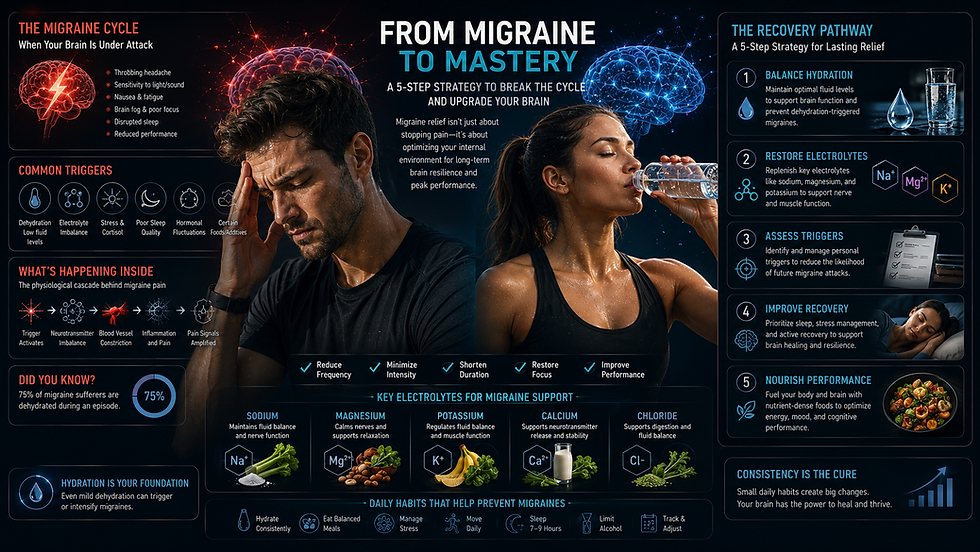
The BRAIN Protocol: A Human Performance Approach to Migraines, Hydration, and Electrolyte Balance
Most people think about migraines only after symptoms begin.
The pounding headache. The light sensitivity. The nausea. The brain fog. The desire to lie down in a dark room and wait for it to pass.
But from a human performance perspective, one of the most important questions is "What happened before the migraine?"
Hydration status. Sleep quality. Stress levels. Electrolyte balance. Recovery. Training load. Travel. Nutrition.
All of these variables can influence the physiological environment in which migraines develop.
This is why Human Performance HQ developed the BRAIN Protocol.
Not as a treatment plan.
But as a framework for supporting the systems that influence brain performance and resilience.
B — Balance Hydration
Many people underestimate how much fluid they lose throughout the day.
Exercise, Heat, Travel, Caffeine, Alcohol, and Poor hydration habits.
All can contribute to a progressive hydration deficit.
The goal isn't simply drinking more water.
The goal is maintaining consistent hydration throughout the day.
This is especially important for individuals who experience:
Frequent headaches
Exercise-induced headaches
Travel-related headaches
Heat-related headaches
Hydration is one of the simplest variables to improve.
Yet it is often overlooked.
R — Restore Electrolytes
Water alone may not always be sufficient.
Electrolytes help regulate:
Fluid balance
Nervous system communication
Muscular function
Cardiovascular performance
For individuals who Sweat heavily, Exercise regularly, Work outdoors, Practice hot yoga, and Travel frequently, electrolyte replacement may become increasingly important.
The objective isn't maximizing electrolytes.
It's maintaining balance.
A — Assess Triggers
Migraine triggers vary significantly between individuals.
Common triggers include:
Sleep disruption
Dehydration
Stress
Alcohol
Certain foods
Hormonal changes
Heat exposure
Keeping a simple journal can help identify patterns.
The goal isn't obsessing over every variable.
It's recognizing recurring trends.
I — Improve Recovery
Recovery influences the brain just as much as it influences muscles.
Many migraine sufferers live in a constant state of physiological strain.
Sleep becomes inconsistent.
Stress accumulates.
Recovery suffers.
Improving recovery behaviors may help reduce overall physiological load.
N — Nourish Performance
The brain requires fuel.
Hydration.
Nutrition.
Sleep.
Movement.
Recovery.
These are performance inputs.
The better the inputs, the better the environment supporting brain function.
Why Sleep May Be More Important Than Most People Realize
One of the strongest predictors of migraine susceptibility is poor sleep.
Research published in Cephalalgia and other headache journals has repeatedly identified sleep disruption as a common migraine trigger.
This makes physiological sense.
Sleep supports:
Brain recovery
Hormonal regulation
Energy restoration
Nervous system function
When sleep quality declines, the brain becomes more vulnerable to stressors.
Many people focus exclusively on hydration while ignoring sleep.
The reality is that both matter.
If you've read our articles on:
you already understand that recovery drives performance.
The brain follows the same rule.
Why Athletes Are More Vulnerable Than They Think
Athletes often assume headaches are part of training.
Sometimes they are.
But they shouldn't automatically be ignored.
Training increases:
Sweat losses
Fluid requirements
Electrolyte losses
Recovery demands
Endurance athletes are particularly susceptible because prolonged exercise creates substantial physiological strain.
Research published in Sports Medicine has demonstrated that endurance exercise can significantly influence hydration status and electrolyte balance.
This does not mean every post-workout headache is caused by dehydration.
But hydration deserves consideration.
Especially when headaches consistently occur after exercise.
Military Personnel and Tactical Athletes
Few populations understand environmental stress better than military personnel.
Field training, Heat exposure, Sleep restriction, Load carriage, and Operational stress.
These variables frequently overlap with known headache triggers.
Research from Human Performance Resources by CHAMP (HPRC) continues to emphasize hydration as a foundational component of readiness.
This isn't simply about physical performance.
It's about cognitive performance.
Decision-making.
Reaction time.
Situational awareness.
The brain performs best when hydration supports it.
Shift Workers: The Overlooked Population
One group that rarely gets discussed in hydration and migraine conversations is shift workers.
Consider:
Nurses
Physicians
Firefighters
Police officers
Air traffic controllers
Pilots
These individuals frequently experience:
Sleep disruption
Circadian rhythm disturbances
Chronic stress
Irregular eating schedules
Many of these factors overlap with migraine triggers.
Hydration alone will not solve these challenges, but supporting hydration and electrolyte balance may help reduce one source of physiological strain.
This is why hydration should be viewed as part of a broader performance strategy rather than an isolated intervention.
Why Travel Headaches Are So Common
One of the most searched questions online is "Why do I get headaches when I travel?"
The answer is often multifactorial.
Travel frequently combines:
Dehydration
Poor sleep
Time zone changes
Altered meal schedules
Increased stress
Commercial airline cabins typically operate at humidity levels significantly lower than most indoor environments.
This contributes to fluid loss.
Many travelers arrive already mildly dehydrated.
Then they add:
Coffee
Alcohol
Outdoor activities
Reduced sleep
The result can be a perfect environment for headaches.
This is one reason hydration planning is often one of the easiest travel performance upgrades.
A Practical Electrolyte Strategy for Headache-Prone Individuals
Many readers want actionable guidance.
While migraine management should always involve healthcare professionals when appropriate, several practical hydration strategies may help support overall brain performance.
Start with consistency.
Don't wait until symptoms appear.
Maintain regular hydration habits throughout the day.
Pay attention to:
Sweat losses
Exercise volume
Heat exposure
Travel schedules
Sleep quality
Consider electrolyte support when physiological demands increase.
Particularly during long workouts, hot environments, travel, and heavy sweating.
Most importantly, remember that hydration is only one piece of the puzzle.
The goal is supporting the entire system.
Top 7 Situations Where Electrolytes May Help Reduce Hydration-Related Headache Risk
While electrolytes are not migraine treatments, they may help support hydration in situations where fluid and electrolyte losses are elevated.
Long endurance workouts.
Hot weather training.
Hot yoga sessions.
Construction and outdoor labor.
Military field exercises.
Long travel days.
Illness involving excessive fluid losses.
These scenarios increase the likelihood of dehydration and electrolyte depletion.
Addressing hydration proactively may help support overall performance and well-being.
How Creatine and Electrolyte Packets Like HPSTIX Help With Migraines.
Hydration is about more than sports. It's about human performance. The brain. The body. Recovery. Daily energy. Cognitive function. We sometimes get headaches because we are chronically dehydrated. I created this product around the idea that hydration should be convenient and practical.
Whether you're:
Training hard
Traveling
Working outdoors
Managing long shifts
Practicing hot yoga
supporting hydration helps support performance, and performance starts with supporting your optimal physiology.
Stay Connected With Human Performance HQ
Join the Human Performance HQ newsletter at the bottom of this page for evidence-based education on hydration, recovery, nutrition, cognitive performance, sleep, and human performance optimization.
Get science-backed strategies delivered directly to your inbox.
Perform. Evolve. Achieve.
FAQs
Do electrolytes help migraines?
Electrolytes are not a cure for migraines, but they may help support hydration status in individuals whose migraines are influenced by dehydration or fluid imbalance. Sodium, potassium, and magnesium all contribute to normal nervous system and fluid regulation functions. If dehydration is a trigger, improving hydration and electrolyte balance may reduce one potential source of physiological stress.
Can dehydration cause migraines?
Dehydration is one of the most commonly reported migraine triggers. Reduced fluid availability can influence blood volume, nervous system function, and overall physiological stress. While dehydration is not the cause of all migraines, it is a factor worth addressing because it is one of the most controllable variables.
Which electrolyte is best for migraines?
Magnesium receives the most attention in migraine research because it influences nerve function, neurotransmitter activity, and blood vessel regulation. However, sodium and potassium also play important roles in hydration and nervous system communication. The best approach is maintaining overall electrolyte balance rather than focusing exclusively on a single mineral.
Does magnesium help migraines?
Research suggests magnesium may help reduce migraine frequency in some individuals, particularly those with low magnesium status. Organizations such as the American Migraine Foundation recognize magnesium as one of the more extensively studied nutritional approaches in migraine management. However, responses vary between individuals.
Why do I get headaches after exercise?
Exercise-induced headaches can have multiple causes including dehydration, electrolyte losses, heat exposure, blood pressure changes, and inadequate recovery. Individuals who sweat heavily or train in hot environments may benefit from evaluating hydration and electrolyte intake. Consistent post-exercise headaches should be discussed with a healthcare professional.
Can low sodium cause headaches?
Low sodium levels can contribute to symptoms such as headaches, fatigue, confusion, and dizziness. This is particularly relevant for individuals who consume large amounts of water without replacing electrolytes during prolonged sweating. Maintaining appropriate sodium balance helps support fluid regulation and nervous system function.
Are electrolyte drinks good for headaches?
Electrolyte drinks may help support hydration-related headaches when fluid and electrolyte losses are contributing factors. They are not treatments for all headache types, but they can be useful during exercise, travel, heat exposure, or other situations involving increased sweat losses. The key is matching hydration strategies to physiological demands.
RESEARCH BACKED CITATIONS
American Migraine Foundation. Magnesium and Migraine.https://americanmigrainefoundation.org/resource-library/magnesium/
American Migraine Foundation. Understanding Migraine.https://americanmigrainefoundation.org
Armstrong, L. E., Ganio, M. S., Casa, D. J., Lee, E. C., McDermott, B. P., Klau, J. F., Jimenez, L., Le Bellego, L., Chevillotte, E., & Lieberman, H. R. (2012). Mild dehydration affects mood in healthy young women. The Journal of Nutrition, 142(2), 382–388.https://academic.oup.com/jn/article/142/2/382/4630789
Ganio, M. S., Armstrong, L. E., Casa, D. J., McDermott, B. P., Lee, E. C., Yamamoto, L. M., Marzano, S., Lopez, R. M., Jimenez, L., Le Bellego, L., Chevillotte, E., & Lieberman, H. R. (2011). Mild dehydration impairs cognitive performance and mood of men. The Journal of Nutrition, 141(8), 1535–1540.https://academic.oup.com/jn/article/141/8/1535/4630591
Kelman, L. (2007). The triggers or precipitants of the acute migraine attack. Cephalalgia, 27(5), 394–402.https://pubmed.ncbi.nlm.nih.gov/17403039/
Popkin, B. M., D'Anci, K. E., & Rosenberg, I. H. (2010). Water, hydration, and health. Nutrition Reviews, 68(8), 439–458.https://academic.oup.com/nutritionreviews/article/68/8/439/1841926
Martin, V. T., & Behbehani, M. M. (2001). Toward a rational understanding of migraine trigger factors. Medical Clinics of North America, 85(4), 911–941.https://pubmed.ncbi.nlm.nih.gov/11480262/


