
Benefits of Taking Creatine Before Bed
Updated: Oct 8
The Overlooked Recovery Strategy for Performance, Sleep, and Brain Health

Most people obsess over one question when it comes to creatine:
Should I take it before my workout or after my workout?
Entire social media debates have been built around the topic. Supplement companies market specific timing windows. Fitness influencers argue over whether pre-workout or post-workout creatine produces superior muscle growth.
Yet almost nobody asks a far more interesting question.
What happens if you take creatine before bed?
At first glance, the answer seems simple.
Our SLEEP Protocol gives you a solid and easy framework to follow!
Research consistently shows that daily creatine saturation matters far more than precise timing. If you're taking creatine consistently, you're already receiving the majority of its performance benefits.
But stopping there misses an enormous opportunity.
Because while creatine may not magically build more muscle simply because it's consumed before sleep, nighttime supplementation intersects with something incredibly important:
recovery.
And recovery is where human performance is built.
Every adaptation you're chasing, whether it's muscle growth, strength, cognitive performance, resilience, recovery, body composition, or longevity, ultimately occurs between workouts, not during them.
Training is the stimulus.
Recovery is where the adaptation happens.
And sleep is the most powerful recovery tool humans possess.
This raises a fascinating question:
Could taking creatine before bed support the physiological processes that occur while we sleep?
The answer is more nuanced than most articles suggest. And it reveals why creatine has evolved from a bodybuilding supplement into one of the most researched human performance supplements available.
The Truth About Creatine Timing
Before discussing nighttime supplementation specifically, it's important to understand one fundamental principle.
Caffeine produces immediate effects.
Creatine produces cumulative effects.
The benefits of creatine come primarily from increasing phosphocreatine stores within muscle tissue and other organs over time.
Research from the International Society of Sports Nutrition (ISSN) consistently identifies creatine monohydrate as one of the safest and most effective evidence-based supplements for improving exercise performance, lean mass development, recovery, and potentially cognitive function (Kreider et al., 2017).
This means that if your muscles are fully saturated with creatine, the difference between taking it at 8:00 AM versus 8:00 PM is often relatively small.
However, that doesn't mean timing is completely irrelevant. Because while creatine saturation drives most of the benefits, the physiological environment surrounding supplementation may influence how those benefits integrate into your overall recovery strategy.
That's where sleep enters the conversation.
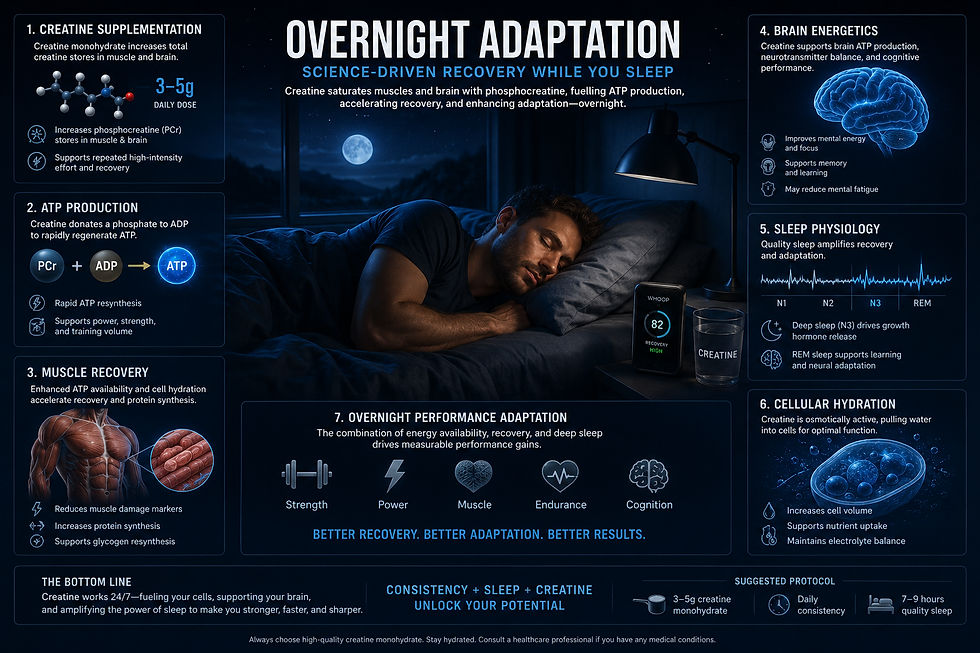
Most people think sleep is passive. It isn't.
Sleep is one of the most metabolically active recovery periods in the human body.
During sleep, the body is performing an enormous amount of work behind the scenes.
Muscle protein remodeling occurs.
Hormonal regulation occurs.
Tissue repair occurs.
Neurological recovery occurs.
Memory consolidation occurs.
Immune system function is optimized.
Energy stores are replenished.
The glymphatic system increases activity, helping clear metabolic waste products from the brain.
From a human performance perspective, sleep is not downtime. It's reconstruction time.
Research published in Nature and Science of Sleep highlights the critical role sleep plays in physical recovery, cognitive performance, hormonal regulation, and athletic adaptation (Watson, 2017).
This is why sleep quality often predicts performance outcomes better than many training variables.
You don't grow stronger while lifting weights.
You grow stronger while recovering from lifting weights.
The same principle applies to nearly every aspect of human performance.
Why Creatine Is More Than a Muscle Supplement
One of the biggest misconceptions about creatine is that it only benefits bodybuilders.
That narrative is outdated.
Modern research continues expanding our understanding of creatine far beyond muscle growth.
Creatine helps support ATP regeneration.
ATP is the primary energy currency used by virtually every cell in the body.
Every muscular contraction requires ATP.
Every nerve impulse requires ATP.
Every cognitive process requires ATP. It's been shown to improve cognitive function, depressive symptoms, and ADHD symptoms.
Even sleep itself requires ATP. Studies show that short-term sleep deprivation can be combated by "mega" dosing creating at 20-30g after a bad night's sleep. So it you're looking to perform optimally, give this a try!
This becomes particularly important when discussing recovery.
While muscles contain the largest stores of creatine, the brain also utilizes creatine to support energy metabolism.
Research by Rawson and Venezia suggests creatine may support cognitive function, particularly during periods of metabolic stress, sleep deprivation, and aging (Rawson & Venezia, 2011).
This means the conversation is no longer:
"Does creatine help build muscle?"
The better question is:
"How does creatine support energy-demanding systems throughout the body?"
When viewed through that lens, nighttime supplementation becomes much more interesting.
Ariel Hernandez's Perspective: Most People Are Asking the Wrong Question
Ariel says, whether creatine before bed is superior, he would likely tell you that most people are focusing on the wrong variable.
The real question isn't:
"Is nighttime creatine better?"
The real question is:
"Does nighttime creatine fit into a recovery strategy that supports high-level performance?"
From Ariel's experience working with military personnel, tactical athletes, healthcare workers, endurance athletes, and high-performing professionals, the individuals who achieve the greatest results are rarely obsessed with supplement timing.
They're obsessed with consistency.
However, Ariel also recognizes that bedtime routines are often one of the most reliable behavioral anchors people have.
Many people forget morning supplements. Many skip post-workout nutrition. Few people forget to go to bed.
This makes nighttime supplementation potentially valuable not because the clock matters, but because consistency matters.
As he often explains "The best supplement protocol is the one you'll actually follow for years." This is where bedtime creatine becomes practical.
Not because it's magical.
Because it's sustainable.
Creatine and Sleep Quality: What Does the Research Say?
One of the most common questions people ask is:
Does creatine help you sleep?
Current evidence suggests the answer is probably not directly.
Creatine is not a sleep aid.
It does not function like melatonin.
It does not appear to induce sleepiness.
It does not significantly alter sleep architecture in healthy individuals.
However, the relationship between creatine and sleep becomes much more interesting when sleep quality is less than ideal.
Several studies suggest creatine may help support cognitive performance during periods of sleep deprivation.
Research by McMorris et al. found creatine supplementation improved certain aspects of cognitive function under sleep-deprived conditions.
Similarly, studies investigating military populations have observed improvements in cognitive performance during stressful or sleep-restricted environments.
This is particularly relevant because modern society is increasingly sleep deprived.
Many individuals are not asking:
"Can creatine improve perfect sleep?"
They're asking:
"Can creatine help me function when sleep isn't perfect?"
The evidence here becomes much more compelling.
Why Shift Workers May Benefit the Most
One of the most under-discussed populations in sports nutrition is shift workers.
Think about:
Nurses
Physicians
Firefighters
Police officers
Pilots
Military personnel
Emergency responders
These professions often involve:
Sleep disruption
Circadian rhythm challenges
High stress
Cognitive demands
Physical demands
Research published in Nutrients has increasingly examined creatine's role in supporting cognitive resilience under conditions of physiological stress and fatigue.
For shift workers, creatine may offer benefits extending far beyond physical performance.
This is where creatine transitions from a fitness supplement into a human performance tool.
The Brain Runs on Energy Too
When people think about ATP, they usually picture muscles.
But the brain is one of the most energy-demanding organs in the body.
Although it represents only about 2% of body weight, it consumes approximately 20% of total energy expenditure at rest.
Maintaining focus, memory, reaction time, attention, and decision-making requires enormous amounts of cellular energy.
Research by Avgerinos and colleagues reviewed creatine supplementation and cognitive performance, suggesting potential benefits in memory, intelligence tasks, and mental fatigue resistance under certain conditions (Avgerinos et al., 2018).
This becomes particularly relevant for:
Students
Executives
Healthcare workers
Military personnel
Entrepreneurs
Anyone performing cognitively demanding work
The conversation around creatine is rapidly evolving.
The future isn't simply about muscle.
It's about cognitive performance.
The SLEEP Protocol for Nighttime Creatine
One of the simplest frameworks for using creatine before bed is the SLEEP Protocol.
S — Saturate Daily
Creatine works through saturation.
Consistency matters more than perfection.
Focus on daily intake rather than chasing optimal timing.
L — Leverage Consistency
Bedtime routines are highly repeatable.
Attaching creatine to an existing nighttime habit improves long-term adherence.
E — Enhance Recovery
Remember why you're taking creatine.
The goal is supporting ATP availability, recovery, and performance adaptation.
E — Evaluate Performance
Pay attention to:
Recovery
Training quality
Cognitive performance
Energy levels
Performance is feedback.
P — Pair With Hydration
Creatine and hydration work together.
Supporting cellular hydration may enhance overall recovery and performance outcomes.
This is one reason many athletes pair creatine with hydration-focused strategies rather than treating them separately.
Why Creatine and Hydration Are Connected
One of the most misunderstood aspects of creatine is its relationship with hydration.
Many people still believe creatine causes dehydration.
Research does not support this claim.
In fact, evidence suggests creatine may support intracellular water retention and cellular hydration.
This is an important distinction.
Hydration is not simply about total body water.
It's about where water is distributed.
Creatine helps draw water into muscle cells, supporting the intracellular environment where performance and recovery processes occur.
This is one reason creatine fits naturally within broader hydration discussions.
If you've read our articles on:
you've already seen how hydration influences nearly every aspect of human performance.
Creatine complements that conversation.
How Single Serve Creatine and Electrolyte Packets Like HPSTIX Fit Into a Nighttime Recovery Routine
Most people think about recovery only after hard workouts.
But recovery is happening every day.
Hydration.
Sleep.
Nutrition.
Stress management.
Cellular energy production.
These systems work together.
I developed HPSTIX around a simple idea: Support hydration and performance in a convenient format that fits modern lifestyles, while supporting behavioral change with simplicity and convenience.
For individuals already using creatine as part of their routine, combining hydration-focused strategies with consistent creatine intake may help support recovery, training quality, and long-term performance.
Because the goal isn't simply recovering from today's workout.
The goal is preparing for tomorrow's performance.
Stay Connected With Human Performance HQ
Join the Human Performance HQ newsletter at the bottom of this blog for evidence-based insights on hydration, recovery, nutrition, cognitive performance, and human performance optimization.
Perform. Evolve. Achieve.
FAQs
Is it okay to take creatine before bed?
Yes. Current evidence suggests creatine can be taken before bed without negatively affecting sleep quality in most healthy individuals. Since creatine works through saturation rather than acute effects, nighttime supplementation is often a practical way to maintain consistency. Many people find bedtime routines easier to follow than pre- or post-workout supplementation schedules.
Does creatine affect sleep quality?
Research does not currently show that creatine significantly improves or worsens sleep quality in healthy individuals. However, some studies suggest creatine may help support cognitive performance during periods of sleep deprivation. This distinction is important because supporting performance under poor sleep conditions is different from directly improving sleep itself.
Can creatine cause insomnia?
There is currently no strong evidence suggesting creatine causes insomnia in healthy individuals. Most people tolerate creatine well regardless of the time of day it is consumed. If someone experiences sleep disturbances, other factors such as caffeine intake, stress, or overall sleep hygiene are more likely contributors.
Is taking creatine at night better than taking it in the morning?
Not necessarily. Research consistently shows that total daily creatine intake and long-term saturation matter more than exact timing. However, nighttime supplementation may improve consistency for individuals who already have a structured bedtime routine.
Does creatine help recovery while sleeping?
Creatine supports ATP regeneration, muscular performance, and recovery processes throughout the body. Since many recovery adaptations occur during sleep, maintaining adequate creatine stores may indirectly support overnight recovery. The benefit comes from saturation rather than a unique nighttime effect.
Can creatine help brain function?
Emerging research suggests creatine may support certain aspects of cognitive performance, particularly under conditions of stress, sleep deprivation, or mental fatigue. The brain requires significant amounts of ATP, and creatine may help support cellular energy availability within neural tissue.
Should shift workers take creatine before bed?
Shift workers may be among the populations most likely to benefit from creatine supplementation because of their elevated physical and cognitive demands. Whether taken before bed or another consistent time of day, creatine may help support recovery, cognitive resilience, and performance during irregular schedules.
Research Backed Citations
Avgerinos, K. I., Spyrou, N., Bougioukas, K. I., & Kapogiannis, D. (2018). Effects of creatine supplementation on cognitive function of healthy individuals: A systematic review of randomized controlled trials. Experimental Gerontology, 108, 166-173.
Candow, D. G., Forbes, S. C., Chilibeck, P. D., et al. (2019). Variables influencing the effectiveness of creatine supplementation as a therapeutic intervention for sarcopenia. Frontiers in Nutrition, 6, 124.
Kreider, R. B., Kalman, D. S., Antonio, J., et al. (2017). International Society of Sports Nutrition Position Stand: Safety and efficacy of creatine supplementation in exercise, sport, and medicine. Journal of the International Society of Sports Nutrition, 14(18).
McMorris, T., Harris, R. C., Swain, J., et al. (2007). Effect of creatine supplementation and sleep deprivation on cognitive performance. Journal of Sports Sciences, 25(10), 1103-1112.
Rawson, E. S., & Venezia, A. C. (2011). Use of creatine in the elderly and evidence for effects on cognitive function in young and old. Amino Acids, 40(5), 1349-1362.
Watson, A. M. (2017). Sleep and athletic performance. Nature and Science of Sleep, 9, 1-8.


