
Does Creatine Make You More Hungry? The Truth About Appetite, Weight Gain, and Muscle Growth
Updated: Oct 8
If you've recently started taking creatine and noticed you're suddenly raiding the pantry, craving larger meals, or feeling hungry more often throughout the day, you're not alone, it's one of the most common questions people ask after starting creatine supplementation:
"Does creatine make you more hungry?"
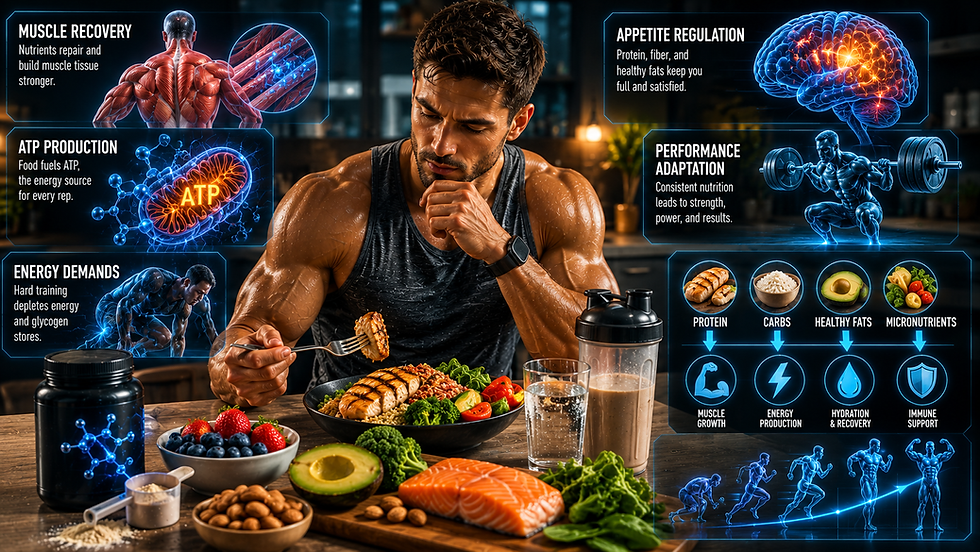
For many people, the timing seems obvious.
You start taking creatine, and a few weeks later:
Your appetite increases.
You find yourself eating more.
You crave larger portions.
You feel hungry sooner after meals.
The natural assumption is, "Creatine must be making me hungry." But when we look at the science, the answer becomes much more interesting.
Current research does not show that creatine directly stimulates hunger hormones the way certain medications or metabolic conditions can.
However, creatine is often introduced at the exact same time people begin:
Strength training
Building muscle
Exercising more frequently
Improving recovery
Increasing physical activity
Those changes absolutely can increase appetite.
In other words, the hunger may be real, but creatine itself may not be the direct cause.
If you've already read our Human Performance HQ articles on:
you've probably noticed a recurring theme:
Many creatine myths originate from confusing correlation with causation.
This topic is one of the best examples.
Let's dive into what the research actually shows.
The Short Answer: Does Creatine Make You More Hungry?
Current evidence suggests,
Creatine does not directly increase appetite in most people.
There is no strong evidence showing creatine supplementation consistently increases:
Hunger hormones
Appetite regulation
Food cravings
Caloric intake
However, creatine can indirectly influence behaviors and physiological adaptations that may increase appetite over time.
For example, if creatine helps you:
Train harder
Recover better
Build more muscle
Exercise more consistently
your body's energy demands may increase, and when energy demands increase, hunger often follows.
This distinction is incredibly important, because many people blame the supplement when the real cause is the lifestyle change occurring alongside it.
What Does the Research Say About Creatine and Appetite?
One of the most surprising things you'll discover when reviewing the literature is that appetite is rarely listed as a primary effect of creatine supplementation.
Most creatine research focuses on:
Strength
Power
Lean mass
Recovery
Exercise performance
Cognitive performance
Very few studies demonstrate direct appetite stimulation.
In fact, the overwhelming majority of research suggests creatine's primary mechanism involves:
ATP regeneration
Cellular energy production
Muscle phosphocreatine stores
Not appetite regulation. This means there is currently little evidence supporting the idea that creatine directly triggers hunger.
Why People Think Creatine Increases Hunger
If research doesn't support a direct effect, why do so many people swear creatine makes them hungry?
The answer often comes down to timing.
Think about when most people start taking creatine.
It's usually during periods when they're also:
Beginning a gym program
Increasing training volume
Building muscle
Following a new nutrition plan
Pursuing performance goals
All of those factors can increase energy expenditure, and increased energy expenditure often increases appetite.
The supplement gets blamed because it's the newest variable, but it may not be the true driver.
Creatine and Muscle Growth

One of the most evidence-supported benefits of creatine is its ability to support lean mass gains when combined with resistance training.
As muscle mass increases, energy requirements often increase as well. Muscle tissue is metabolically active. Maintaining more lean tissue requires energy. Over time, this can contribute to increased caloric needs.
Which may result in:
Larger appetites
Increased food intake
More frequent hunger signals
Again, this isn't necessarily creatine causing hunger, it's often the result of physiological adaptations occurring alongside successful training.
Why Building Muscle Often Makes You Hungrier
Many people underestimate how demanding muscle growth can be.
Building muscle requires:
Recovery resources
Protein synthesis
Training adaptations
Energy availability
When your body begins adapting to resistance training, it often seeks additional fuel.
This may manifest as:
Increased hunger
Larger meal sizes
More frequent snacking
Stronger food cravings
Because creatine supports training performance, it can indirectly contribute to this process, but the key player remains:
The training adaptation. Not the supplement itself.
Creatine and Exercise Volume
One overlooked effect of creatine is that it often helps people train harder.
Research consistently shows creatine can improve:
Strength output
Power production
Training volume
Repeated high-intensity performance
If you're completing:
More sets
More reps
More training sessions
your caloric expenditure increases. When energy expenditure increases, hunger frequently follows. This is one reason many athletes report increased appetite after beginning a successful training phase.
Why Better Recovery Can Increase Appetite
Recovery is another factor many people overlook.
When recovery improves, individuals often:
Feel better
Move more
Train harder
Maintain greater consistency
All of these behaviors require energy.
As discussed in our article, Benefits of Taking Creatine Before Bed, recovery influences nearly every aspect of performance.
Improved recovery can create a positive cycle:
Better recovery → Better training → Greater energy demands → Increased appetite.
Once again, the appetite increase is indirect.
The Difference Between Hunger and Recovery Signals
One of the most fascinating concepts in human performance is that people often misinterpret recovery signals as hunger.
After hard training, your body may be seeking:
Carbohydrates
Protein
Fluids
Electrolytes
Many individuals simply interpret these needs as, "I'm starving."
In reality, the body may be communicating a broader recovery demand.
This becomes especially relevant when training intensity increases.
Does Creatine Increase Metabolism?
Another common myth is that creatine dramatically increases metabolism.
The truth is more nuanced.
Creatine itself is not a stimulant.
Unlike caffeine, it does not directly increase metabolic rate through nervous system stimulation.
However, creatine may indirectly influence energy expenditure through:
Increased lean mass
Improved training quality
Greater exercise output
These effects may contribute to higher overall energy needs, but they're not the same as a direct metabolic boost.
Why Active People Usually Feel Hungrier

Consider two individuals:
Person A
Sedentary lifestyle
Minimal exercise
Low daily energy expenditure
Person B
Strength trains four days per week
Walks daily
Uses creatine
Progressively overloads workouts
Who is likely to feel hungrier?
Almost always Person B.
Not because creatine magically stimulates appetite, but because Person B's body is performing more work. Energy demands drive appetite far more than most supplements.
Creatine, Weight Gain, and Appetite Confusion
Another reason people assume creatine increases hunger is because they often see the scale increase.
As discussed in, Does Creatine Water Weight Go Away? early creatine supplementation frequently increases:
Muscle hydration
Intracellular water retention
Body weight
When people see the scale rise, they often become hyper-aware of everything else happening in their body.
Including appetite.
This heightened awareness can create the impression that creatine is causing hunger when multiple variables are changing simultaneously.
Ariel Hernandez's Perspective: Correlation Is Not Causation
One thing Ariel Hernandez frequently sees in both military and civilian populations is the tendency to blame the newest variable.
Someone starts:
Creatine
A lifting program
Higher protein intake
Better recovery habits
all at the same time.
Then they notice they're hungrier.
The immediate conclusion becomes, "Creatine caused it."
From Ariel's perspective, "Most people don't realize they're training harder, recovering better, moving more, and building muscle at the same time they're taking creatine."
The supplement gets all the credit, or all the blame, but human physiology is rarely that simple.
Ariel often encourages clients to ask, "What else changed?" before assuming a supplement is responsible, because in many cases, increased hunger is actually a sign that:
Training is improving.
Recovery demands are increasing.
Adaptation is occurring.
And those are often positive developments.
The FUEL Protocol: Understanding Hunger, Recovery, and Creatine
One of the biggest mistakes people make when evaluating supplements is assuming every change they experience comes directly from the supplement itself.
Human physiology is rarely that simple.
That's why Human Performance HQ developed the FUEL Protocol.
Not as a diet plan.
But as a framework for understanding why hunger sometimes increases when people begin using creatine.
F — Focus on Facts
Current research does not show that creatine directly stimulates appetite hormones in a meaningful way. Separate evidence from assumptions.
U — Understand Energy Needs
As training volume and intensity increase, caloric demands often increase. Hunger frequently reflects those increased demands.
E — Evaluate Recovery
Recovery requires energy. Better recovery often supports greater training output, which may increase appetite.
L — Look Beyond the Supplement
When hunger changes, ask:
Did training volume increase?
Did activity levels increase?
Did recovery improve?
Did muscle mass increase?
The answer is often larger than creatine itself.
7 Reasons You Might Feel Hungrier After Starting Creatine

1. You're Training Harder
This is arguably the most common explanation. Creatine helps improve:
Strength
Power
Repeated high-intensity performance
As a result, many people unintentionally increase:
Training volume
Total workload
Weekly exercise output
More work requires more fuel, and more fuel often means more hunger.
2. You're Recovering Better
Recovery itself is an energy-demanding process. When recovery improves, your body may:
Repair tissue more efficiently
Rebuild glycogen more effectively
Support muscle adaptation
These processes require resources. Sometimes increased hunger is simply your body asking for those resources.
3. You're Moving More Throughout the Day
One overlooked effect of improved fitness is that people often become more active outside the gym.
Researchers refer to this as, Non-Exercise Activity Thermogenesis (NEAT) Examples include:
Walking more
Taking stairs
Standing longer
Being more physically active
These seemingly small behaviors can substantially increase caloric expenditure.
4. You're Building Lean Muscle Mass
As discussed in, Does Creatine Water Weight Go Away? And Should I Take Creatine If I Don't Workout? Creatine helps support lean mass development when paired with resistance training.
Muscle tissue requires energy to build and maintain, and as lean mass increases, energy needs often increase as well.
5. Your Workouts Are Higher Quality
Many people focus only on workout duration, but workout quality matters too.
If creatine helps you:
Lift heavier
Complete more reps
Increase training intensity
you may create a larger recovery demand.
Larger recovery demands often produce stronger hunger signals.
6. You're Finally Fueling Properly
This is surprisingly common.
Many people begin:
Strength training
Supplementation
Performance-focused nutrition
at the same time.
For the first time in years, they may actually be supporting their body's needs.
The result? They become more aware of legitimate hunger signals.
7. You're Paying More Attention
Human psychology matters.
When people begin a new supplement, they often become hyper-aware of:
Weight fluctuations
Hunger
Recovery
Energy levels
Sometimes increased awareness creates the impression that the supplement caused the change.
This doesn't mean the experience isn't real, it simply means the cause may be more complex.
Does Creatine Increase Metabolism?
This question appears frequently online.
The answer is,
Not directly in the way most people think.
Creatine is not:
A stimulant
A thermogenic
A fat burner
Unlike caffeine, creatine does not directly increase metabolic rate through nervous system stimulation.
However, creatine may indirectly influence metabolism through:
Increased lean mass
Better training performance
Greater activity levels
These factors can increase overall energy expenditure over time.
Can Creatine Cause Weight Gain?
Yes, but context matters.
As discussed in, Does Creatine Water Weight Go Away? the most common early weight gain from creatine is related to:
Muscle hydration
Intracellular water retention
This is not the same thing as fat gain.
Over time, additional weight gain may also result from:
Increased muscle mass
Improved training outcomes
Neither of these should automatically be viewed negatively.
Creatine and Weight Loss
Many people avoid creatine because they think it will sabotage fat loss.
The evidence suggests otherwise.
Creatine can support:
Strength maintenance
Lean mass preservation
Training quality
during periods of caloric restriction.
These benefits may actually improve body composition outcomes. The scale may not always tell the full story, but body composition often does.
Should You Take Creatine During a Calorie Deficit?
In most cases, yes.
One of the biggest challenges during dieting is maintaining:
Strength
Performance
Lean tissue
Creatine may help support these goals.
This is why many athletes continue supplementing during:
Fat-loss phases
Cutting phases
Competition preparation
The objective isn't weight gain. The objective is performance preservation.
Why Appetite Isn't Always the Enemy
Many people view hunger as something negative, but hunger is often information, and it's your body's way of communicating.
The key is determining what the signal means.
Sometimes hunger reflects:
Increased activity
Increased recovery needs
Muscle growth
Greater energy expenditure
Understanding the context helps determine whether action is needed.
Common Myths About Creatine and Hunger
Myth #1: Creatine Directly Stimulates Hunger
Current evidence does not support this claim. Most appetite changes likely result from training and lifestyle factors.
Myth #2: If You're Hungrier, Creatine Is Causing It
Not necessarily. Many variables often change simultaneously when people begin supplementation.
Myth #3: Hunger Means You're Gaining Fat
False.
Hunger simply indicates a need for energy.
Whether that energy becomes:
Recovery
Muscle growth
Fat storage
depends on the broader nutritional context.
Myth #4: You Should Stop Creatine If Appetite Increases
Not necessarily.
First evaluate:
Activity levels
Training volume
Recovery demands
Body composition changes
before assuming creatine is the problem.
Ariel Hernandez's Perspective: Hunger Can Be a Sign of Progress
One thing Ariel Hernandez frequently discusses with military personnel, athletes, and clients is that people often fear hunger unnecessarily.
From Ariel's perspective, "If you've spent years under-eating, training inconsistently, and ignoring recovery, improved hunger signals can actually be a sign that your body is adapting."
The goal isn't eliminating hunger. The goal is understanding it.
Many people begin taking creatine at the same time they start:
Training harder
Sleeping better
Eating more protein
Recovering more effectively
Then they wonder why they're hungrier.
The answer is often simple, your body is doing more, and doing more requires fuel. The supplement may be along for the ride, but the real driver is often the improved lifestyle that came with it.
Stay Connected With Human Performance HQ
Join the Human Performance HQ newsletter at the bottom of this page for evidence-based education on:
Creatine
Hydration
Recovery
Nutrition
Human performance
Longevity
Cognitive optimization
Get practical, science-backed strategies delivered directly to your inbox.
Perform. Evolve. Achieve.
FAQs
Does creatine make you more hungry?
Current research does not show that creatine directly increases appetite. However, creatine often helps people train harder and recover better, which may increase energy demands and hunger. In many cases, the lifestyle changes accompanying creatine use are more likely responsible for appetite increases than the supplement itself.
Does creatine increase appetite?
There is limited evidence showing a direct effect on appetite regulation. Most increases in hunger appear to be indirect and related to increased activity levels, muscle growth, and recovery demands.
Why am I hungry after starting creatine?
The most likely explanation is that your overall training and recovery demands have increased. Creatine often improves workout quality, which can lead to greater caloric needs and stronger hunger signals.
Does creatine increase metabolism?
Creatine is not a stimulant and does not directly boost metabolism. However, increased lean mass, improved performance, and greater activity levels may indirectly increase energy expenditure over time.
Does creatine make you gain weight?
Yes, but the type of weight matters. Early increases are typically related to intracellular water retention. Long-term gains may include lean muscle mass when combined with resistance training.
Can creatine help with weight loss?
Creatine can support fat-loss goals by helping preserve strength and lean mass during a calorie deficit. While the scale may fluctuate, body composition outcomes often improve.
Should I take creatine while dieting?
For most healthy individuals, yes. Creatine may help maintain training quality, preserve muscle mass, and support performance while calories are reduced.
RESEARCH BACKED CITATIONS
Kreider, R. B., Kalman, D. S., Antonio, J., Ziegenfuss, T. N., Wildman, R., Collins, R., Candow, D. G., Kleiner, S. M., Almada, A. L., & Lopez, H. L. (2017). International Society of Sports Nutrition position stand: Safety and efficacy of creatine supplementation in exercise, sport, and medicine. Journal of the International Society of Sports Nutrition, 14(18). https://doi.org/10.1186/s12970-017-0173-z
Antonio, J., Candow, D. G., Forbes, S. C., Gualano, B., Jagim, A. R., Kreider, R. B., Rawson, E. S., Smith-Ryan, A. E., VanDusseldorp, T. A., Willoughby, D. S., & Ziegenfuss, T. N. (2021). Common questions and misconceptions about creatine supplementation: What does the scientific evidence really show? Journal of the International Society of Sports Nutrition, 18(13). https://doi.org/10.1186/s12970-021-00412-w
Jagim, A. R., Kerksick, C. M., & Campbell, B. I. (2024). Creatine supplementation and human performance: Current evidence and future directions. Nutrients, 16(4), 526. https://doi.org/10.3390/nu16040526
Candow, D. G., Forbes, S. C., Chilibeck, P. D., Cornish, S. M., Antonio, J., & Kreider, R. B. (2021). Creatine supplementation and aging musculoskeletal health. Nutrients, 13(3), 877. https://doi.org/10.3390/nu13030877
Forbes, S. C., Candow, D. G., Ostojic, S. M., Roberts, M. D., & Kreider, R. B. (2022). Creatine supplementation and adaptations to exercise training: A systematic review and meta-analysis. European Journal of Applied Physiology, 122(6), 1307–1324. https://doi.org/10.1007/s00421-022-04904-0
Other Resources
International Society of Sports Nutrition Position Stand on Creatine https://jissn.biomedcentral.com/articles/10.1186/s12970-017-0173-z
Common Questions and Misconceptions About Creatine Supplementation https://jissn.biomedcentral.com/articles/10.1186/s12970-021-00412-w
National Institutes of Health Office of Dietary Supplements https://ods.od.nih.gov
Cleveland Clinic – Creatine Benefits and Safety https://my.clevelandclinic.org/health/treatments/17674-creatine
Examine – Creatine Research Review https://examine.com/supplements/creatine


