
Human Performance Program: The Complete Guide to Building Stronger, Healthier, and More Resilient People
Updated: Oct 8
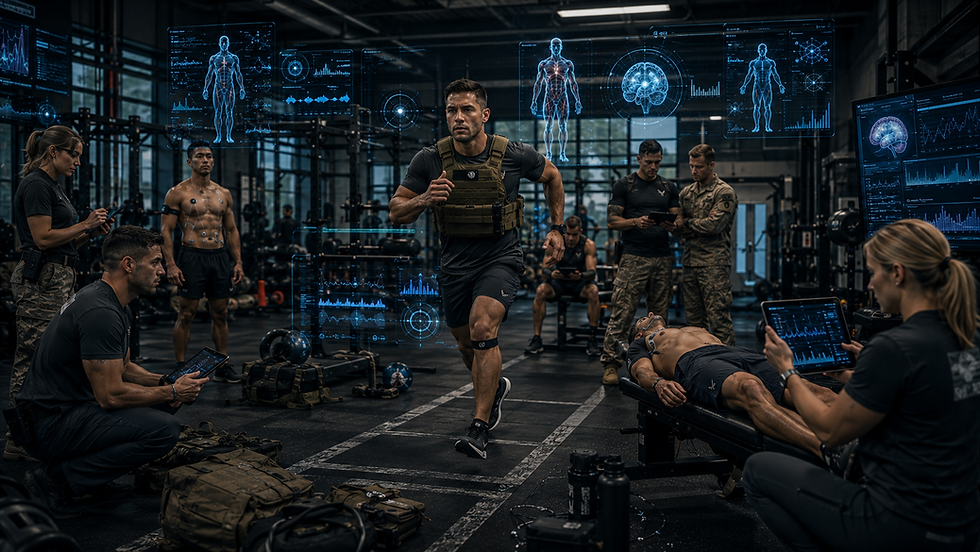
For decades, most organizations approached fitness the same way. Give people access to a gym. Conduct an annual fitness test. Offer occasional nutrition classes. Hope performance improves. Sometimes it did. More often, it didn't.
That's because performance isn't built from one workout, one supplement, or one annual assessment, it's built through a system. That's exactly why Human Performance Programs have become one of the fastest-growing areas in military readiness, professional sports, public safety, healthcare, and corporate wellness.
Instead of treating injuries after they happen or only preparing people for a single event, today's Human Performance Programs integrate multiple disciplines into one coordinated strategy designed to improve physical performance, cognitive function, recovery, resilience, health, and long-term readiness.
Over the last decade, I've had the opportunity to watch this evolution firsthand.
In my experience as a Human Performance Expert, I've helped develop and implement embedded Human Performance Programs supporting the military. I've worked alongside strength coaches, physical therapists, registered dietitians, athletic trainers, physicians, mental health professionals, and operational leaders who all shared one common goal:
Help people perform better before performance declines.
That philosophy has become the foundation of Human Performance HQ.
Whether you're a military member preparing for deployment, an athlete chasing peak performance, a firefighter responding to emergencies, a police officer working rotating shifts, or simply someone who wants to feel healthier and perform better throughout life, the same principles apply.
Human performance isn't about perfection, it's about creating systems that help people consistently operate closer to their potential.
In this guide, you'll learn:
What a Human Performance Program is
Why Human Performance Programs are replacing traditional wellness programs
How the military is leading the way through Integrated Operational Support (IOS), Army Holistic Health and Fitness (H2F), and Special Operations Human Performance
How firefighters, law enforcement, Border Patrol, and the Secret Service are adopting tactical human performance
The science behind integrated performance optimization
Why Human Performance HQ was built around these same principles
The Short Answer
A Human Performance Program is a multidisciplinary system that integrates exercise science, strength and conditioning, nutrition, recovery, sleep optimization, injury prevention, performance psychology, and medical support to improve an individual's physical, cognitive, and occupational performance.
Unlike traditional fitness programs that focus primarily on exercise, Human Performance Programs optimize the entire person using evidence-based strategies that improve performance, reduce injury risk, and support long-term health.
What Is a Human Performance Program?

Think of a Human Performance Program as the operating system behind high performance.
Rather than asking, "How do we get someone stronger?" it asks, "How do we help someone consistently perform at their highest level?"
That difference changes everything. A modern Human Performance Program typically combines:
Strength and conditioning
Exercise physiology
Sports nutrition
Recovery science
Sleep optimization
Physical therapy
Athletic training
Performance psychology
Mobility and movement assessment
Injury prevention
Health coaching
Data analytics and performance monitoring
Each discipline works together rather than independently. That's what makes these programs so effective. Performance isn't determined by one variable, it's the product of many systems working together.
The Evolution of Human Performance Programs
The concept of Human Performance didn't begin in the military. It began in elite athletics.
Professional sports organizations realized decades ago that athletic performance wasn't determined solely by talent or coaching.
The teams that consistently won championships invested in:
Strength coaches
Athletic trainers
Sports dietitians
Physical therapists
Exercise physiologists
Sports psychologists
Recovery specialists
Instead of treating injuries after they occurred, they began optimizing performance before problems developed.
Over time, this philosophy expanded beyond sports.
Today, Human Performance Programs can be found in:
Professional sports
Olympic training centers
NCAA athletics
Military organizations
Federal law enforcement agencies
Fire departments
Healthcare systems
Fortune 500 companies
Executive leadership programs
The mission remains the same, help people perform better while reducing unnecessary breakdown.
From Fitness to Readiness

One of the most important shifts happening today is the move from fitness to readiness.
Traditional fitness programs often focus on:
Body weight
Appearance
Annual testing
Short-term goals
Human Performance Programs focus on:
Occupational readiness
Injury resilience
Recovery
Cognitive performance
Long-term health
Sustainable habits
As someone working in military Human Performance, I believe this is one of the biggest advancements we've made over the last decade.
We're no longer asking, "Can this person pass a fitness test?" We're asking, "Can this person consistently perform under demanding conditions?"
Those are very different questions.
Military Human Performance: Leading the Future
Few organizations have invested in Human Performance as aggressively as the U.S. military. Modern warfare demands more than strength. Today's service members must sustain high levels of physical and cognitive performance under stress, fatigue, heat, sleep deprivation, and repeated operational demands.
That's why each branch has developed programs that move beyond traditional physical training.
Air Force Integrated Operational Support (IOS)
The Air Force has embraced Human Performance through Integrated Operational Support (IOS) and Operational Support Teams (OSTs).
Rather than relying solely on annual fitness testing, embedded teams work directly with operational units to improve readiness throughout the year.
These teams often include:
Strength and Conditioning Coaches
Physical Therapists
Athletic Trainers
Registered Dietitians
Mental Health Professionals
Operational Psychologists
Human Performance Program Managers
The goal isn't simply improving Physical Fitness Readiness Assessment (PFRA) scores. It's reducing injuries, improving resilience, increasing mission readiness, and keeping Airmen healthy enough to perform throughout demanding careers.
This represents a major cultural shift from reactive healthcare toward proactive performance optimization.
The Ariel Hernandez Perspective
Human Performance isn't simply something I've researched. It's something I've helped build.
One of my earliest opportunities came while supporting a Pararescue Squadron, where I helped establish an embedded Human Performance program designed specifically for tactical operators.
The mission wasn't to create another gym. The mission was to integrate strength and conditioning, injury prevention, nutrition, recovery, and performance coaching into the daily operational culture of the squadron.
Working with rescue personnel quickly reinforced an important lesson. Operational athletes don't need cookie-cutter fitness programs. They need individualized systems that prepare them for unpredictable physical demands.
Later, I helped establish another Human Performance Center supporting Conventional Military force. Rather than focusing solely on annual fitness testing, the vision centered on creating a culture where readiness became part of everyday life. Strength training, mobility, recovery, nutrition, and injury prevention were integrated into a comprehensive performance model that reflected the Military's growing commitment to proactive health and operational readiness. The project was recognized through official Air Force coverage and represented an exciting step forward in how installations support their people.
I didn't create this platform because I wanted another fitness website. I created it because I believe the same integrated approach used inside military Human Performance Programs should be available to everyone.
Army Holistic Health and Fitness (H2F)
If there's one program that's fundamentally changed tactical human performance, it's the Army's Holistic Health and Fitness (H2F) initiative. H2F is one of the largest investments in human performance ever undertaken by the U.S. military.
Rather than viewing fitness as physical training alone, H2F recognizes that readiness depends on five interconnected domains:
Physical Readiness
Nutritional Readiness
Mental Readiness
Spiritual Readiness
Sleep Readiness
Every Brigade Combat Team is designed to receive an integrated team of experts, including strength coaches, physical therapists, occupational therapists, athletic trainers, registered dietitians, cognitive performance specialists, and other healthcare professionals.
What makes H2F remarkable isn't simply its size, it's its philosophy. The Army acknowledges that performance is influenced by far more than exercise. That's a message I've been advocating throughout my career.
USSOCOM and Preservation of the Force & Family (POTFF)

Before many conventional military organizations embraced Human Performance, U.S. Special Operations Command (USSOCOM) was already investing heavily in integrated performance support.
The Preservation of the Force & Family (POTFF) program combines multiple specialties into one coordinated system designed to sustain elite operators over long careers.
Services commonly include:
Strength and conditioning
Physical therapy
Sports medicine
Nutrition
Sleep optimization
Cognitive performance
Performance psychology
Family support
The lesson here is important. Elite performance isn't maintained through harder training alone. It's maintained through better recovery, smarter programming, and comprehensive support.
Marine Corps and Navy Human Performance
The Marine Corps and Navy have also expanded Human Performance initiatives in recent years.
The Marine Corps has invested in programs such as the Force Fitness Instructor (FFI) program, which embeds trained Marines within units to improve physical readiness, educate leaders, and reduce preventable injuries. Their approach emphasizes functional fitness, combat readiness, and sustainable training rather than simply preparing Marines for a fitness test.
The Navy has expanded Human Performance through initiatives that support tactical communities, aviation, diving, and special warfare. Many programs emphasize sleep optimization, strength and conditioning, nutrition, recovery, and resilience to help Sailors meet the demands of operational environments.
Although each service approaches Human Performance differently, they all share the same underlying philosophy: Build healthier people before performance declines.
Why Integrated Programs Work Better
One reason Human Performance Programs consistently outperform traditional wellness programs is because they acknowledge a simple reality:
Everything is connected.
Poor sleep affects recovery.
Poor recovery affects training.
Poor training affects body composition.
Body composition affects movement quality.
Movement quality influences injury risk.
Nutrition impacts every one of those variables.
Instead of treating these issues separately, integrated Human Performance Programs address them together. That's why they produce better long-term outcomes.
Common Misconceptions About Human Performance Programs
"They're only for Special Operations."
Not anymore.
Today, Human Performance Programs support conventional military units, firefighters, law enforcement officers, healthcare workers, executives, athletes, and everyday adults.
"They're just strength programs."
Strength is only one piece of the puzzle.
Modern Human Performance Programs integrate nutrition, sleep, recovery, psychology, mobility, and injury prevention into one comprehensive system.
"Human Performance is only about elite athletes."
Some of the greatest benefits occur among everyday people.
Improving movement, sleep, nutrition, and recovery can dramatically improve quality of life regardless of occupation or fitness level.
10 Characteristics of a Successful Human Performance Program
Leadership support.
Multidisciplinary collaboration.
Evidence-based decision making.
Individualized programming.
Injury prevention.
Performance monitoring.
Recovery education.
Nutrition integration.
Long-term habit development.
Continuous assessment and improvement.
Looking Beyond One Organization
Perhaps the most exciting part of Human Performance is that it's no longer confined to one profession.
The principles that help a Special Operations operator recover between missions are remarkably similar to those that help a firefighter finish a 24-hour shift, a Border Patrol agent work in extreme environments, or a busy parent keep up with their children.
Human Performance is becoming less about occupation and more about optimizing the human behind the profession. That shift is exactly why I believe this field will continue to grow over the next decade.
Tactical Human Performance Beyond the Military
Although the military has become one of the largest adopters of integrated Human Performance Programs, it isn't the only profession moving in this direction.
Over the last decade, agencies responsible for public safety have increasingly recognized that their personnel are occupational athletes.
Police officers don't know when they'll need to sprint after a suspect.
Firefighters may climb multiple flights of stairs while wearing over 70 pounds of protective equipment.
Border Patrol Agents routinely work in extreme heat, rugged terrain, and remote environments.
Secret Service agents must remain physically and mentally sharp during long protective operations where a split-second decision can change history.
These professions share something in common: Performance isn't optional. It's mission-critical. That's why more organizations are moving beyond traditional fitness programs toward integrated Human Performance models.
Human Performance in Law Enforcement
Historically, many law enforcement agencies focused on academy fitness standards and annual physical testing.
Today, progressive departments are investing in officer wellness and performance programs that extend throughout an officer's career.
Modern law enforcement Human Performance Programs often include:
Strength and conditioning
Tactical fitness
Injury prevention
Sleep education
Recovery strategies
Mental resilience
Nutrition coaching
Mobility assessments
Peer support
Stress management
This shift is important because policing places enormous demands on both physical and cognitive performance.
Shift work, sleep disruption, chronic stress, prolonged sitting, and sudden high-intensity physical encounters all increase the risk of injury and burnout.
Research consistently demonstrates that improving physical fitness reduces musculoskeletal injuries, improves decision-making under stress, and supports long-term career longevity.
Human Performance in the Fire Service
Firefighters have long been recognized as occupational athletes.
Every emergency call can demand:
Maximal strength
Cardiovascular endurance
Heat tolerance
Load carriage
Grip strength
Cognitive decision-making under fatigue
Unfortunately, cardiovascular disease remains one of the leading causes of duty-related firefighter fatalities.
That's why organizations like the International Association of Fire Fighters (IAFF) developed the Wellness-Fitness Initiative, emphasizing year-round health rather than periodic fitness evaluations.
Modern fire department Human Performance Programs commonly include:
Occupational strength training
Functional movement assessments
Heat acclimation
Aerobic conditioning
Recovery protocols
Nutrition counseling
Mobility training
The philosophy mirrors military Human Performance remarkably well. Train for the demands of the occupation, not simply for a fitness assessment.
Border Patrol and Federal Law Enforcement
The U.S. Border Patrol and other federal agencies face unique operational challenges.
Agents often perform physically demanding tasks while operating in:
Extreme heat
Mountainous terrain
Remote desert environments
Long-duration patrols
These conditions demand far more than general fitness. They require:
Aerobic endurance
Lower-body strength
Hydration strategies
Heat resilience
Recovery planning
Injury prevention
Similarly, agencies such as the FBI, DEA, U.S. Marshals Service, ATF, and Secret Service increasingly recognize the value of treating personnel as tactical athletes.
Many agencies now incorporate performance professionals, evidence-based conditioning, and wellness initiatives into recruit academies and continuing education. The focus is shifting from passing an entrance test to sustaining performance throughout an entire career.
The National Strength and Conditioning Association (NSCA) Tactical Annual Training
One of the most influential organizations driving this evolution is the National Strength and Conditioning Association (NSCA).
Its Tactical Strength and Conditioning (TSAC) community has become one of the leading resources for professionals working with military personnel, law enforcement officers, firefighters, and first responders.
Each year, the NSCA Tactical Annual Training conference brings together:
Strength and conditioning coaches
Exercise physiologists
Physical therapists
Registered dietitians
Physicians
Researchers
Military Human Performance leaders
Public safety professionals
The conference focuses on translating the latest evidence into practical strategies for improving readiness, reducing injuries, and enhancing occupational performance.
One theme consistently emerges:
The future of tactical performance is integrated.
No single discipline can optimize performance alone. Collaboration produces better outcomes.
As someone whose worked in Air Force Human Performance, I find tremendous value in following the research and best practices shared through the TSAC community because it reinforces what we've experienced in operational environments: performance improves when professionals work together rather than independently.
The Human Performance HQ Performance Systems Framework
One of the reasons I created Human Performance HQ is because I wanted to make integrated Human Performance accessible outside of military installations and elite sports organizations.
Not everyone has access to an embedded Human Performance team, but everyone can build an integrated performance system. Instead of chasing isolated hacks, focus on improving eight interconnected pillars.
That's why I teach what I call the
Performance Systems Framework.
P — Physical Preparation
Develop:
Strength
Endurance
Power
Mobility
Stability
Your body should be prepared for the demands of your life, not just your workouts.
E — Energy Management
Performance depends on producing and sustaining energy. Prioritize:
Aerobic conditioning
Appropriate fueling
Hydration
Recovery between sessions
R — Recovery
Recovery deserves the same attention as training. Schedule:
Sleep
Mobility
Deload weeks
Stress reduction
Active recovery
F — Fuel
Nutrition should support performance, not restrict it. Focus on:
High-quality protein
Whole-food carbohydrates
Healthy fats
Micronutrient-rich foods
O — Operational Readiness
Ask yourself, "Could I physically handle the demands of my profession or lifestyle today?"
If the answer is no, adjust your training.
R — Resilience
Develop the ability to recover from stress. Physical resilience supports mental resilience, and vice versa.
M — Measurement
Track meaningful metrics such as:
Strength
Aerobic fitness
Waist-to-height ratio
Sleep quality
Resting heart rate
HRV
Mobility
Recovery
Data guides improvement.
A — Adaptation
The body constantly adapts. Training should evolve alongside your goals, age, occupation, and life circumstances.
The Ariel Hernandez Perspective
I have previously established Human Performance Centers within the Air Force fundamentally changed how I view health. When we developed programs supporting a Pararescue Squadron, success wasn't measured by how many people lifted heavier weights. Success was measured by whether operators could stay healthy enough to complete their mission.
Later, established the Human Performance Center at Osan Air Base, I saw how an installation-wide approach could influence culture. When leaders, medical professionals, coaches, and operational units aligned around the same mission, performance became everyone's responsibility rather than one person's job.
The highest-performing organizations don't rely on motivation. They build systems. That's the philosophy behind Human Performance HQ. Whether you're a service member, athlete, first responder, executive, or someone simply trying to become healthier, the fundamentals remain the same.
Build a system. Follow it consistently. Allow time to work in your favor.
10 Characteristics of World-Class Human Performance Programs
Leadership commitment from the top down.
Multidisciplinary collaboration.
Evidence-based decision making.
Individualized programming.
Injury prevention as a primary objective.
Continuous education for participants.
Performance data collection and monitoring.
Integration of physical and cognitive performance.
Year-round readiness instead of event preparation.
A culture that values sustainable performance over short-term results.
FAQs
What is a Human Performance Program?
A Human Performance Program is an integrated system that combines exercise science, strength and conditioning, nutrition, recovery, sleep, injury prevention, and behavioral strategies to improve physical and cognitive performance. Unlike traditional wellness programs, it focuses on optimizing the whole person rather than addressing isolated issues. The goal is sustained readiness, resilience, and long-term health.
How is a Human Performance Program different from a wellness program?
Wellness programs often emphasize general health education or periodic fitness initiatives. Human Performance Programs integrate multiple specialists who collaborate to improve measurable outcomes such as strength, endurance, recovery, injury rates, and occupational performance. They are proactive rather than reactive and are built around continuous improvement.
Which military branches use Human Performance Programs?
Every branch of the U.S. military has invested in Human Performance in different ways. The Air Force uses Integrated Operational Support (IOS) and Operational Support Teams, the Army has Holistic Health and Fitness (H2F), USSOCOM operates the Preservation of the Force & Family (POTFF) program, and both the Marine Corps and Navy have expanded tactical performance initiatives focused on readiness, resilience, and injury prevention.
Are Human Performance Programs only for military personnel?
No. Human Performance Programs are increasingly common in professional sports, fire departments, law enforcement agencies, federal organizations, healthcare systems, and corporate environments. The same principles that improve military readiness also help executives manage stress, athletes improve performance, and older adults maintain independence.
Why are integrated Human Performance Programs more effective?
Performance is influenced by multiple interconnected factors, including training, nutrition, sleep, hydration, recovery, mental resilience, and movement quality. Improving only one area often produces limited results. Integrated programs coordinate these disciplines so improvements in one area reinforce progress in others.
How do Human Performance Programs reduce injuries?
These programs emphasize proactive strategies such as movement assessments, workload monitoring, progressive strength training, mobility, recovery planning, and education. By identifying risk factors early and improving overall physical capacity, Human Performance Programs help reduce overuse injuries while supporting long-term occupational readiness.
How can I build my own Human Performance Program?
Start by focusing on the fundamentals: strength training, aerobic conditioning, quality nutrition, hydration, sleep, recovery, and consistent monitoring of your progress. You don't need access to an elite Human Performance Center to apply these principles. Small, sustainable habits practiced consistently often produce the greatest long-term improvements.
Key Takeaways
If there's one message I hope you take from this guide, it's this:
Human Performance Programs are about systems, not shortcuts.
The future of performance is integrated, multidisciplinary, and proactive.
Military organizations, professional sports, public safety agencies, and healthcare systems are all moving toward the same philosophy: optimize people before performance declines.
Readiness extends beyond physical fitness to include nutrition, recovery, sleep, mental resilience, and behavior.
Sustainable habits consistently outperform temporary motivation.
Everyone, not just elite athletes, can benefit from Human Performance principles.
Continue Your Human Performance Journey
Continue exploring Human Performance HQ:
Join the Human Performance HQ Newsletter
If you're passionate about improving your health, performance, and longevity, subscribe to the Human Performance HQ Newsletter.
You'll receive practical, research-backed strategies covering fitness, nutrition, recovery, sleep, hydration, tactical performance, and healthy aging, all designed to help you:
PERFORM | EVOLVE | ACHIEVE
RESEARCH BACKED CITATIONS AND HUMAN PERFORMANCE RESOURCES
Department of the Air Force. Integrated Operational Support (IOS) and Operational Support Teams. https://www.airforcemedicine.af.mil/
Department of the Army. FM 7-22 Holistic Health and Fitness (H2F). https://armypubs.army.mil/ProductMaps/PubForm/Details.aspx?PUB_ID=1025968
U.S. Special Operations Command. Preservation of the Force & Family (POTFF). https://www.socom.mil/POTFF
National Strength and Conditioning Association. Tactical Strength and Conditioning (TSAC) Program. https://www.nsca.com/certification/tsac-f/
National Strength and Conditioning Association. Tactical Annual Training. https://www.nsca.com/events/tactical-annual-training/
International Association of Fire Fighters. Wellness-Fitness Initiative. https://www.iaff.org/wellness-fitness-initiative/
Garber, C. E., Blissmer, B., Deschenes, M. R., et al. (2011). Quantity and Quality of Exercise for Developing and Maintaining Cardiorespiratory, Musculoskeletal, and Neuromotor Fitness in Apparently Healthy Adults. Medicine & Science in Sports & Exercise, 43(7), 1334–1359. https://journals.lww.com/acsm-msse/fulltext/2011/07000/quantity_and_quality_of_exercise_for_developing.26.aspx
Simpson, N. S., Gibbs, E. L., & Matheson, G. O. (2017). Optimizing Sleep to Maximize Performance: Implications and Recommendations for Elite Athletes. Scandinavian Journal of Medicine & Science in Sports. https://onlinelibrary.wiley.com/doi/10.1111/sms.12703
Sawka, M. N., Burke, L. M., Eichner, E. R., et al. (2007). American College of Sports Medicine Position Stand: Exercise and Fluid Replacement. Medicine & Science in Sports & Exercise, 39(2), 377–390. https://journals.lww.com/acsm-msse/fulltext/2007/02000/exercise_and_fluid_replacement.22.aspx


